How our collection reflects (anti-)racism.
By Saskia Lindhout
The news has been full of it these past months; people around the world took to the streets to protest against racism and racist police violence. Black Lives Matter and similar anti-racism movements were suddenly everywhere in the foreground. Companies, influencers and celebrities saw the hype and gratefully made use of it; suddenly celebrities were posting videos with #itakeresponsibility[1], everyone joined in with #blackouttuesday[2] and various companies presented themselves as supporters of the movement through statements on their social media[3].
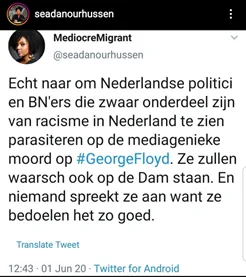
Many people of colour who have always been actively engaged in the fight against racism criticised this exploitation of the publicity around the movement. Munroe Bergdorf, the British transgender model, writer and activist, spoke out against the empty declaration of support from L'Oréal Paris[4]. Bergdorf worked on a campaign for the brand in 2017, but was dismissed after four days because of something she said online against racism. Seada Nourhussen, writer, journalist and commentator, also noted that a great deal of support and good intentions from the world of the famous suddenly appeared in the media. Often it came from well-known Dutch people who had never before shown themselves to be activist on the subject and who did not seem to be taking any further action for structural change either[5].
In this, Bergdorf and Nourhussen join a large group of critical activists, including the authors of the articles cited so far. In the middle of the storm of trendy online anti-racism, they say out loud what marginalised groups have known for generations: anti-racism is not a trend, not something you can latch onto temporarily to improve your image or sell more products. Racism is a systemic injustice and it does not disappear without concrete action.
In a society where whiteness holds a position of power, engaging with (anti-)racism is a choice, not a necessity. At least, for white people. The fact is that people of colour have been making the same points for decades without being listened to consistently. That is how it can be that white people are now shocked and bewildered by expressions of racism, large and small, that Philomena Essed already described extensively in the 1980s in her book Alledaags racisme (Everyday Racism). That having a Black partner does not exempt you from racism, for example (p. 70), or that the Zwarte Piet debate is really not only a matter of recent years (p. 157). This phenomenon itself was also long and widely known: that people of colour can shout as hard and as long as they like and still barely seem to reach the dominant white group. As described in Albert Memmi's Racisme, hoezo? (1983): "the voice of the oppressed is little heard, if not systematically suppressed" (p. 60). And so a combination of disinterest and disbelief sees to it, time and again, that the problem of 'racism' disappears from the white collective memory.
One of our main aims as MHM is therefore to safeguard testimonies of human experience, including of racism.
At the Moluks Historisch Museum we see a task for ourselves here. Experiences of racism, at all kinds of levels, are inherent in both Moluccan and Indo history. One of our main aims as MHM is therefore to safeguard testimonies of human experience, including of racism. Managing and opening up heritage may sound dusty, but it is not. Our collection is a life-size databank of evidence for that which is not believed or understood by those who do not experience it, or have not experienced it. Experiences of oppression, discrimination, having to fight for your rights and your independence are just as current now as they were hundreds of years ago.
By drawing connections between then and now, and by showing that subjects such as racism and anti-racism follow a line through the centuries, we also give substance to our role as a centre of knowledge. Think not only of books explicitly about the concept of 'racism', but also of works about the freedom fighter Pattimura, the racial argument against mixed marriages, or the exoticisation of 'the native'.
The books discussed and the books pictured here are all part of our library. They were published in the 1970s, 1980s and 1990s and in essence make the same points that anti-racism activists are making right now. What is more, these books already treat racism as a problem, whereas many older books in the collection reflect a time in which the colonial, European perspective on people of colour was the unquestioned norm. Together these books reflect an unmistakable pattern of the same white question, over and over: racism, does that even exist? And over and over the same, often non-white answer: how long do we have to keep shouting before you start seeing this as a problem too?
[1] Coley, Jordan. ""I Take Responsibility" and the limits of celebrity activism." The New Yorker, 12 June 2020. https://www.newyorker.com/culture/cultural-comment/i-take-responsibility-and-the-limits-of-celebrity-activism.
[2] Greenspan, Rachel E. https://www.insider.com/blackout-tuesday-criticism-posts-hide-resources-black-lives-matter-blm-2020-6.
[3] Soudagar, Roxane. "Bedrijven en #BLM: goede sier of oprecht activisme?" OneWorld, 17 July 2020. https://www.oneworld.nl/lezen/discriminatie/racisme/bedrijven-en-blm-goede-sier-of-oprecht-activisme/.
[4] Post by Munroe Bergdorf on the hypocrisy of L'Oréal Paris: https://twitter.com/MunroeBergdorf/status/1267460238678069249.
[5] Post by @seadanourhussen: https://www.instagram.com/p/CA5B1NoFz2m/?utmsource=igwebcopylink.