The Moluccan story hung on photographs
'A photograph says more than a thousand words', people sometimes say. I wonder whether that is really so. It depends on what someone sees in a photograph, or wants to see. It depends on what someone wants to hear, which story someone wants to tell. I put considerations of this kind to those present at the Sophiahof on 15 January. We had come together for the selection of 25 photographs meant to give a picture of the Dutch East Indies, Suriname and the Caribbean islands during the Second World War and shortly afterwards.
That was part of the project 'The Second World War in a hundred photographs', initiated by the NIOD (Institute for War, Holocaust and Genocide Studies). For it, a committee in each province – twelve, plus the so-called overseas territories – chose 50 photographs. From these the public could in turn choose 25. And on 30 March, 100 will be selected from all the photographs for an exhibition in the House of Representatives. The first selection of 50 photographs per province will be used for pop-up exhibitions.
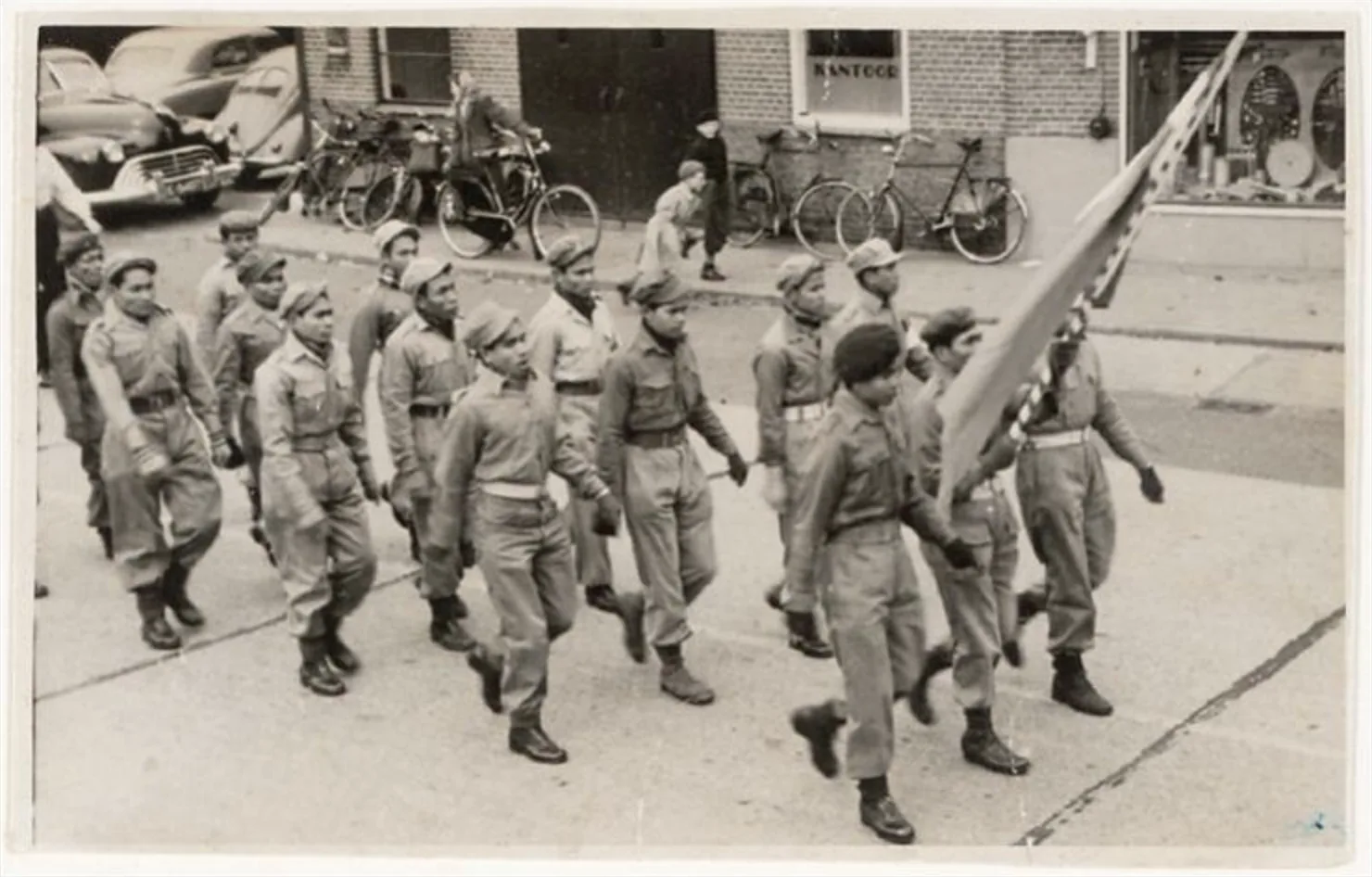
Moluccan ex-KNIL soldiers from the Vossenbosch camp training for the Nijmegen walking march. L to r: A. Tuasela, H. Piris, J. Tuasela, S.A. Uneputty, F.J. Salakory, unknown, A. Sahusilawane, F. Pattiasina (front), P. Maulany (behind), M. Patty, W.D. Sipahelut, A. de Kock (behind), A. Latumahina (dark beret, at the front), D. Pattiasina (partly behind the flag), unknown (entirely behind the flag).
For the selection of the 50 photographs from the 'overseas territories' we drew on various collections, including of course that of the Moluks Historisch Museum. What is special about the latter collection is that it contains photographs you will not find elsewhere, including from the period 1940-1949. That is because they entered the archives through Moluccans. Moluccans went to other places and found other things important to record or to keep as a memento.
One of the photographs we chose shows a group of bare-chested men doing a sports lesson. The photograph was taken in Ambon and dates from 1945. That place and time are remarkable. It is a photograph of the training of KNIL soldiers recruited in the Moluccas after the capitulation of Japan. Shortly after that capitulation the Netherlands was back in the Moluccas and could begin reorganising the KNIL. That is a different story from the one told by photographs from other parts of Indonesia, where the Netherlands was still trying to restore its colonial authority. That single photograph of KNIL soldiers exercising tells us the story of differing situations across the vast Indonesian archipelago. Differences that made it easier, from August 1945, to recruit Moluccans for the KNIL than people from other islands. Against the background of current discussions about decolonisation, that is an important story.
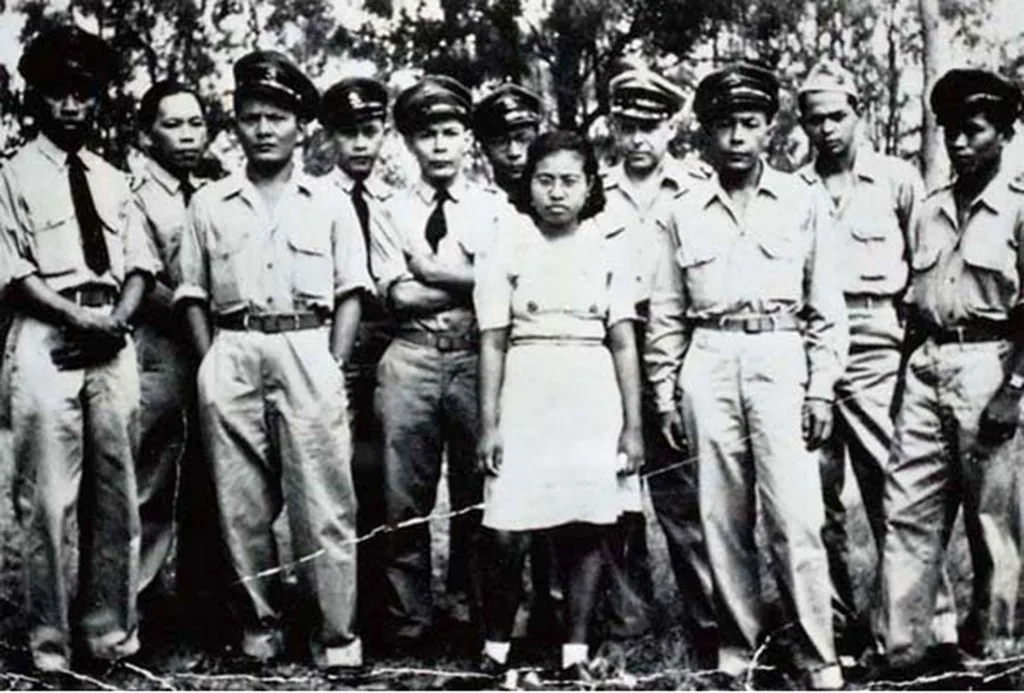
Coos Ayal with 10 of the 17 survivors of the resistance group in New Guinea. The photograph was taken at Camp Wacol, Australia. L to r: Nuhuwae, Sagrang, Soeha, De Mey, Kokkeling, De Kock, Beaufort, Jaquard, Attinger and Sandiman.
Sadly, I think, the photograph did not make the next round and is not among the selection of 25. A photograph from the Moluks Historisch Museum that did make it through is the one of Coosje Ayal, posing with ten of the survivors of the resistance group in New Guinea of which she was part. That too is an important story. But for this photograph as well, you can only tell the story properly if you know what is in the picture. And you have to want to tell the story of Coosje and this resistance group, to consider the story important.
A photograph, in my view, does not tell more than a thousand words. Words are important in order to know what you are seeing in the photograph. The photograph is important in order to give the words depth. Coosje's story gains depth when you see her standing as the only woman among ten men. The story of recruitment for the KNIL immediately after the Japanese capitulation gains a face when you see the Moluccan soldiers exercising and realise that some of them may have been brought to the Netherlands in 1951.
These photographs in the collection of the Moluks Historisch Museum must be cherished, together with the stories, and we must make sure they keep finding their way to a wider audience. As they now do in the project 'The Second World War in a hundred photographs', forming small hooks on which to hang the Moluccan story.
#
Latest posts
#
Search the image archive yourself
#
Visit 'Vechten voor vrijheid. De vele gezichten van verzet'
#
[
](https://www.museum-maluku.nl/exposities/actuele-tentoonstelling/)