This discovery makes something fundamental visible: an archive is never finished. It grows, deepens and changes, precisely through what people recognise and share.
Behind the scenes we are actively working on enriching our archive with metadata. We do this not only from within the museum, but together with the community. During the exhibition In Eigen Woorden and through crowdsourcing activities we invite visitors to add knowledge, names and stories to the collection.
Recently we made a deliberate choice in this. We shared a photograph from the exhibition with an appeal: who recognises the bridal couple? With results. The bridal couple has been identified.
Moments like these show how valuable this way of working is. By working together, images gain meaning and history becomes more concrete and more personal.
There is a misconception in the way archives are often approached, as if you first have to know exactly what you are looking for. In reality it works differently. Sometimes an archive opens up precisely while you are searching. That is exactly what the Museum Maluku online collection makes possible.
With more than 25,000 collection items it is not a static archive, but a dynamic memory of the various Moluccan communities in the Netherlands. And that memory is now accessible 24/7 again.
How do you navigate our online archive?
The threshold is rarely access, but orientation. Where do you begin?
Effective search strategies are concrete and personal:
Family names (surnames, but also variant spellings)
Places of residence in the Netherlands and in the Moluccas
Former camps (such as Schattenberg, Lunetten, etc.)
Years or periods (e.g. the 1950s, 1970s, 1980s)
Specific events or contexts (such as demonstrations, weddings or funerals)
What often happens: you start with one name and end up in a network of recognition. One photograph leads to another family. A place opens a forgotten chapter. That is no coincidence; that is how collective memory works.
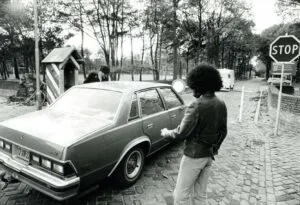
Entrance to the barracks with a guard post at the barrier and a car passing. Beside it a young Moluccan man.
Can you find the photograph above in our online archive? Perhaps you recognise the car's number plate or know which barracks this is. Search for the photograph by document identification number: IWM 071
Not only looking, but recognising
The strength of this collection lies not only in what is visible, but in what it activates. For one person it is a direct search for family history. For another a first introduction to the various Moluccan communities in the Netherlands. And for students and researchers it is a primary source.
There is potential here particularly for a younger generation. Not as an archive, but as a way into identity, history and context. What you find online can be a starting point for conversations at home, new questions or your own research.
Go deeper
The Museum Maluku collection does not stand alone. Anyone who wants to go deeper combines sources. And there lies an important opportunity: connecting platforms.
Molukse Voetstappen An accessible knowledge base with educational material and context. Relevant for pupils, teachers and anyone looking for structure in the story.
Ons Land Focuses on the shared history of the Netherlands and Indonesia and combines archive material with narrative context.
Nationaal Archief For those who want to go into depth, with military files such as the KNIL, government policy and migration history.
Delpher (Koninklijke Bibliotheek) Historical newspapers, magazines and publications. Interesting for seeing how stories were told at the time.
Drents Archief A regional focus, with sources on camps such as Schattenberg among other things.
Westerbork Memorial Centre Specifically relevant for the period in which the camp became a Moluccan camp, with personal record cards and additional context.
These platforms strengthen one another. Where one archive gives a name, another gives context.
The strategic value of the online collection lies not only in accessibility, but in participation. The more often people search, recognise and share, the richer the collective story becomes.
There is a clear invitation in that too, especially to young people: do not wait for history to be told, but start discovering it yourself.