A bamboo flute in ONS LAND
Published on
On Tuesday 8 February, Museum Sophiahof was finally able to open its doors to the public again.
A day to celebrate. Not only because the public can come and visit our museum again, but also because the exhibition ONS LAND, decolonisation, generations, stories has opened after 15 months of preparation. That is a long time, you may think, but in fact the exhibition was realised in a fairly short period. As the Ons Land project team we were supported in this by a number of professionals from the museum world and, from the Moluks Historisch Museum, by junior curator Reïnda Hully and Wim Manuhutu.
The bamboo flute
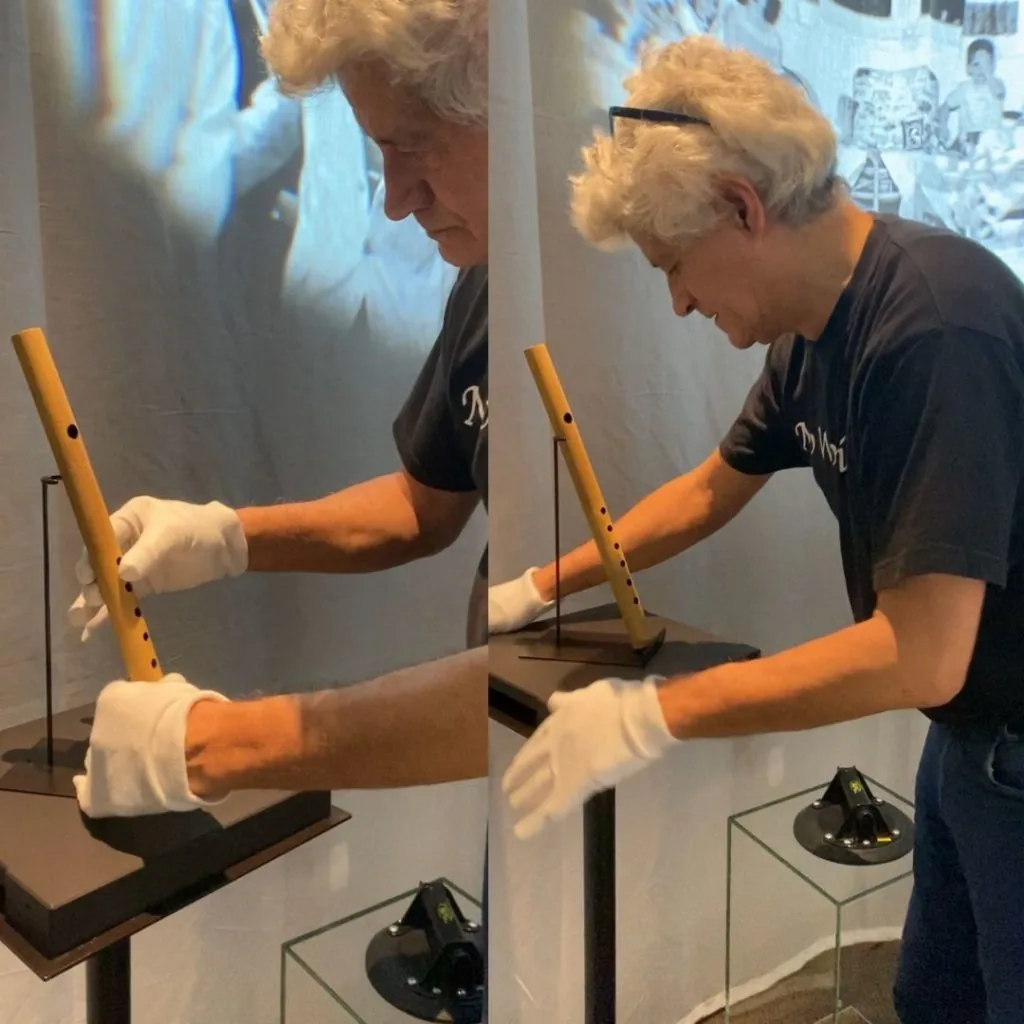
I carefully place the suling (bamboo flute) in the stand that I have positioned at an angle along the diagonal of the display case floor. I turn the suling towards me so that the finger holes are clearly visible. That way the presentation is not too static but has movement in it. Now to fasten everything securely and put the glass cover on. The light falls nicely from above. Seraya Tuasuun films me for a post about the work of a curator. Setting up an exhibition is part of that too.
ONS LAND
Ons Land is a co-production of the Indisch Herinneringscentrum (IHC) and the Moluks Historisch Museum (MHM) and will form the permanent display at Museum Sophiahof for the next 5 years. As curator of the Moluks Historisch Museum, or Museum Maluku, I was closely involved in developing and formulating the exhibition concept. Eight family stories, 5 Indo and 3 Moluccan, form the thread running through the exhibition. They are told by the youngest or a younger generation. From the present they tell of their parents' and grandparents' arrival in the Netherlands, the crossing from the Dutch East Indies and life in the Indies. Personal objects and numerous family photographs support the individual family stories. In choosing the 3 Moluccan family stories we looked at how far they cover the broad Moluccan story, at their layeredness with plenty of room for new perspectives, at unfamiliar images and at surprising objects.
In the end three different stories were chosen. One family story about the KNIL, the Wassenaar action, repatriation to Lombok and the 4th generation in the neighbourhood in Tilburg. The second family story is about the Navy, with first-generation navy man Opa Jacobus Bernardus, Zeeland, New Guinea and doctor and granddaughter Rebecca. The third story is about a Muslim family, about Tulehu, the Wyldemerk camp, repatriation, cooking and 'pulang'.
Project Wyldemerk & you can take part
I will end with the Wyldemerk, the only Islamic camp, near Balk in Friesland. This year Museum Maluku will host the Wyldemerk archaeology project initiated by the archaeologists of the** Moluks Erfgoed foundation. The most important participant in the project is the Moluccan community. Former residents of the Wyldemerk and young Moluccans interested in how to research a camp are warmly invited to take part. Over the past 2 years the Moluks Erfgoed foundation has mapped the locations of numerous Moluccan camps. Other participants in the archaeology project are the Dutch Forestry Commission, the Boei foundation and the Cultural Heritage Agency. The project starts in mid-April 2022 and runs until January 2023. More information about this project can be found at www.molukserfgoed.com. Would you like to take part? Email: h.akihary@museum-maluku.nl**.