On the afternoon of Sunday 21 March the BETADISINI livestream takes place from Museum Sophiahof in The Hague. As a partner, Beyond Walls is responsible for the programme concept and production of the event.
Beyond Walls is an independent collective of cultural professionals, academics and (visual) artists. To get to know them we talk with two team members, Suzanne Rastovac and Glenda Pattipeilohy. Rastovac is a historian, curator and co-founder of Beyond Walls. Pattipeilohy is an educator, curator and event producer; her followers on social media know her from her work in Maluku (for example with Moluccas Coastal Care).

Suzanne Rastovac (left) and Glenda Pattipeilohy (right)
Through their work, Suzanne and Glenda aim to encourage critical, collective awareness, both in institutional spaces and within diaspora communities.
Beyond Walls goes beyond the metaphorical walls that determine that something falls within a boundary, or rather within the 'norm', and is therefore of cultural value. The collective also puts critical questions to the makers and guardians of those walls: why do they decide what counts as cultural heritage and (art) history? Certainly when the historical works belong to a diaspora community.
Beyond Walls also wants to make the intellectual debate around colonial heritage accessible to a wider audience, outside the Randstad and outside institutional frameworks, so that there is greater access to substantive discussion of it.
MHM and Beyond Walls question the norm together
Colonialism is wrongly labelled as something 'that happened so long ago'. Colonial, stereotypical ideas still work through in the policy decisions of museums, educational institutions and government bodies.
The Moluks Historisch Museum and Beyond Walls find common ground in breaking through stereotypical images. In the media and in historiography, Moluccans are still often reduced to stereotypes, with stigmatisation as a result.
To mark 70 years of Moluccans in the Netherlands, the MHM is holding the temporary exhibition Ikat. From March to November 2021 a different pair of artists of Moluccan descent or with a Moluccan connection exhibits each month. Through their work they show what it means to them to be Moluccan in the Netherlands. The paired artists are each from a different generation, practise different disciplines and highlight the many-sidedness of the Moluccan community from their own perspective.
Beyond Walls shares the MHM's aim of contributing to a many-sided image that does justice to the diversity within the Moluccan community. During the livestream broadcast there will be several switches to live recordings in a number of Moluccan neighbourhoods. Ahead of the recordings, Beyond Walls visits the locations to develop an item together with the residents. In this way the programme is made for and by the community.
Making room at the table
In 1979 the American artist Judy Chicago exhibited the iconic feminist installation The Dinner Party. It is a monument to 39 mythical, historical and famous women. Three tables are placed in a triangle, so that no one sits at the head. In the floor tiles, 999 other women are honoured.
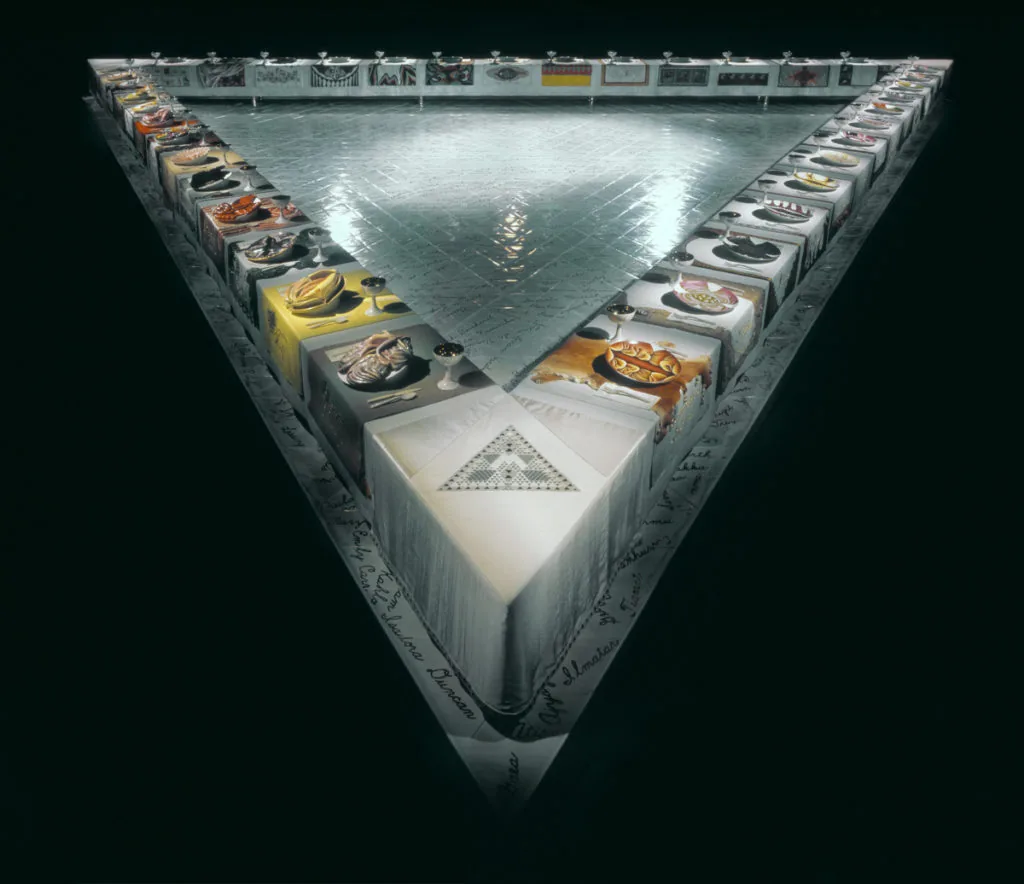
The Dinner Party (1979), Judy Chicago
The Dinner Party gives women a place at the table, literally and figuratively. The work claims access for women to intellectual spaces previously made exclusively by and for men, but which do not belong to them alone.
Guess Who's Coming to Dinner Too? (2019) is a solo exhibition and social monument by artist and activist Patricia Kaersenhout.
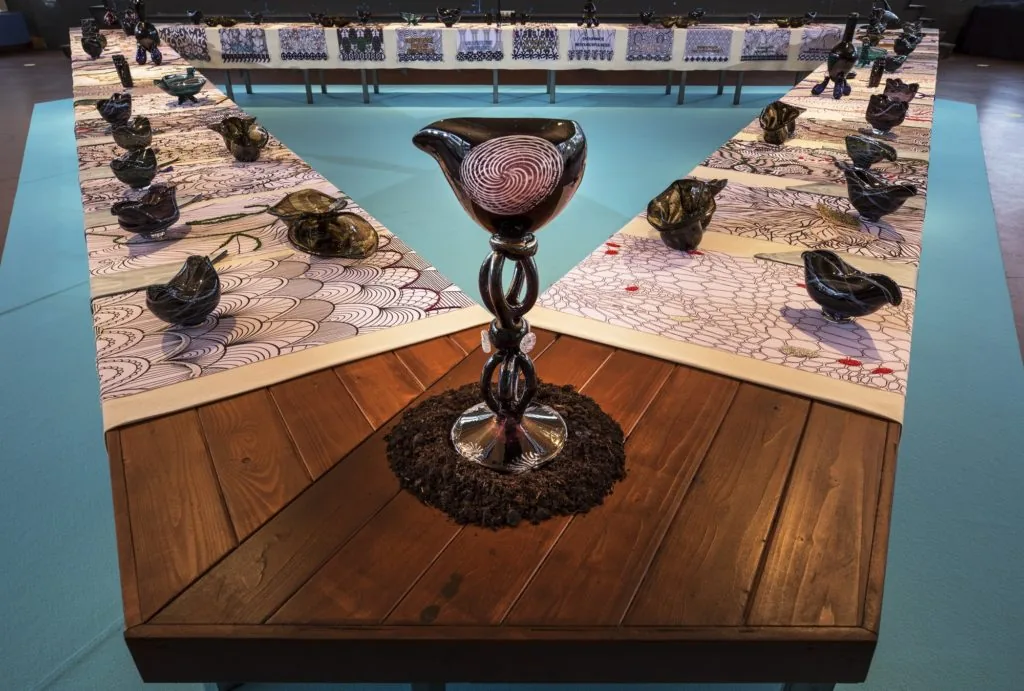
Guess Who's Coming To Dinner Too? (2019), Patricia Kaersenhout
As a 'supplement' to The Dinner Party she made a table consisting exclusively of Black women and women of colour, women who fought and fight against colonialism and racism and against oppression by the patriarchy. Kaersenhout: 'Many women were literally erased, their bodies destroyed so that they would not attain the status of heroines.'
Now you might ask: what do Judy Chicago, Patricia Kaersenhout and Beyond Walls have to do with one another?
None of the three waits to be invited in order to secure a place at the table. They make a table themselves in honour of the people who were not invited before but who do deserve a place at the table where important decisions are made. At that same table, people are invited to take part in the conversation.
In the cultural sector that means, concretely: when an exhibition about people of colour is put together, people of colour are involved at every level of the organisation, throughout the whole process. Only then can people of colour find recognition and justice be done to the many-sidedness of a community.
Moluks Historisch Museum x Beyond Walls
The Moluks Historisch Museum and Beyond Walls share the ambition of creating a safe space for dialogue on 21 March. Beyond Walls has high ambitions for the event. Representation and diversity matter a great deal to them. Glenda hopes that the Moluccan community will feel represented and that the programme does justice to the diversity within the community. Suzanne adds: "And that the broadcast contributes to a more many-sided view of the history and the contemporary context."
With the BETADISINI livestream the MHM also addresses people outside the Moluccan community. The Netherlands does not, after all, stand outside Moluccan history; it is part of it.
Glenda's ambition is, on the one hand, to strengthen the sense of community among Moluccans: "Satu gandong, and not only on the dance floor #maribaikooo!"
At the same time she hopes to offer an inclusive perspective on her own community and beyond. By entering into conversation with other (diaspora) communities in order to learn from one another. And by treating one another with love and respect, so that there is no room to exclude in the same way the Moluccan community has itself experienced.
The programme of the BETADISINI livestream will be announced in the course of the month via museum-maluku.nl and the social channels.