Ambon – Rotterdam – The Hague
These three cities currently have one thing in common: In Eigen Woorden.
While the photographic exhibition travels to various locations in the Netherlands, a special part of the collection has now arrived in a place that feels to many like home. Since 21 June, photographs from In Eigen Woorden have been on view at the Dutch Consulate in Ambon. With that, the exhibition travels not only around the Netherlands but also back to Maluku.
For many visitors that is more than a new exhibition. The photographs show, among others, members of the first generation of Moluccans in the Netherlands. People who once left the land of their birth, whose stories continued in the Netherlands and who are now returning – if only through images – to the place where their history began.
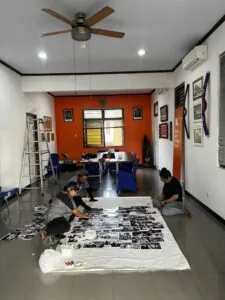
Here a group of artists works on the exhibition in Ambon
Between monument and memory
At the same time, the monument Ulu Kora was unveiled in Rotterdam. Although thousands of kilometres apart, these two events are closely connected. They tell the same story: about memory, identity and the enduring bond between Maluku and the Moluccan diaspora.
Curator Theoresia Rumthe therefore sees the exhibition as much more than a collection of historical photographs.
"When I first visited the exhibition, I did not know the people in the photographs personally. Yet they felt immediately familiar," she says. "I recognised their gestures, their way of laughing, coming together and living. It felt as if I were looking at my own family."
What moved her above all was the resilience the images convey.
"I saw how Moluccans kept caring for one another and kept their way of life, despite displacement, loss and difficult circumstances. That strength is what I wanted to bring back to Maluku."
According to Rumthe, more returns with this exhibition than an archive alone.
"What comes back are also the stories, names and experiences that are part of the history of the Moluccan diaspora. I hope the photographs in Ambon will not be seen as silent archive items, but will come alive again through memories and conversations between generations."
That is precisely where the strength of this exhibition lies. Where a monument offers a physical place for commemoration, photographs invite encounter. They bring faces back into the story and make history personal.
That makes it all the more remarkable that the exhibition in Ambon is taking place at the same moment as the arrival in 1951 is being marked in the Netherlands.
*From Arrival to Future
"Here in Maluku we are celebrating the exhibition, while our brothers and sisters in the Netherlands come together at the monument,"* Rumthe says. "Even though we cannot experience those events directly, we remain connected through our shared history and memories."
Perhaps that is the most important bridge In Eigen Woorden builds. Not only between Ambon, Rotterdam and The Hague, but also between generations.
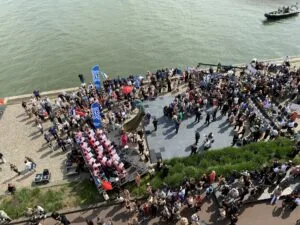
Photo by Uriël Matahelumual, unveiling of Ulu Kora and the commemoration at the Lloydkade in Rotterdam
"We should ask the question more often: where do we come from?" Rumthe says. "Which rituals still live on in our villages? Which cultural traditions do we want to keep? Those are conversations we need to have, within families, between communities and between generations."
When visitors in Ambon walk past the photographs, she hopes above all that they will recognise one thing: resilience.
"You see it in the faces, in the body language, in the way people come together. We are a strong people. But you also see something else: the pleasure of being together. Eating, cooking, dancing and celebrating together. That is also who we are."
For many this moment feels like a circle completed. Photographs that were cherished for years in Moluccan living rooms in the Netherlands are now back on the islands where so many stories began.
Or, as Rumthe puts it herself:
"For me, In Eigen Woorden is a journey home. Not only for these photographs, but also for the memories they carry with them. I hope this is not the end of a journey, but the beginning of new conversations and new connections."
And perhaps that is exactly what this exhibition shows: that distance can change history, but connection never disappears.
This project in Ambon would not have been possible without the effort, involvement and care of many. A special word of thanks goes to Berixter Tiwery, Nassim Abba, Pierre Ajawaila and Theoresia Rumthe for their production, support and dedication in realising the exhibition in Ambon. Thanks to their efforts, the stories, photographs and memories of In Eigen Woorden were able to make a remarkable journey home.
Are you in Ambon? Then the exhibition In Eigen Woorden can be visited from now until 4 July 2026 at the Dutch Consulate in Ambon.
Help record this story
The stories around the National Monument ULU KORA are also being continued on film. Documentary maker Uriël Matahelumual is currently working on the documentary Van Aankomst naar Toekomst (From Arrival to Future), which centres on the history of the Moluccan arrival in the Netherlands, the making of the monument and its meaning for present and future generations. The documentary focuses on the history of the first Moluccan KNIL soldiers and their families, who arrived in the Netherlands in 1951 via the Lloydkade in Rotterdam.
A crowdfunding campaign is currently running to realise this documentary. With a contribution you not only help make the production of the film possible, but also help keep Moluccan history and heritage visible for future generations.
More information and donations: Crowdfunding Van Aankomst naar Toekomst