On 10 May 1951 the 6th transport carrying Moluccan ex-KNIL soldiers and their families arrived in the port of Rotterdam. The Skaubryn had left Surabaya on 14 April. On board were 1,198 Moluccans, among them 9 Moluccan navy men and 563 children. 2 babies died during the crossing.
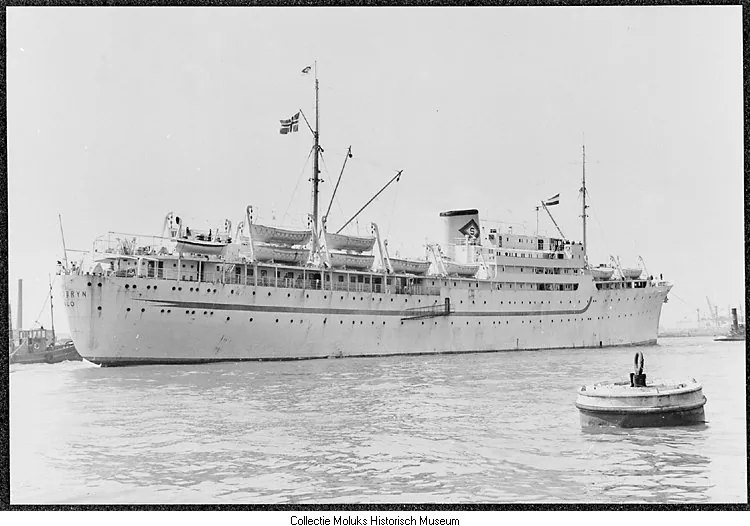
The motor ship Skaubryn was built in Kiel, Germany, on the order of the Norwegian shipping company I.M. Skaugen. In early 1951 she was fitted out in Landskrona, Sweden, as an emigrant ship with 1,000 berths. In March the Skaubryn sailed to Australia for the first time. On her very first homeward voyage she called at Surabaya to take Moluccan soldiers and their families on board, bound for Rotterdam.
More than 100 babies 1,198 Moluccans left Surabaya for the Netherlands on the Skaubryn. That number was made up of 348 Moluccan soldiers with temporary KL status, 9 Moluccan navy men, 276 women and 563 children, more than a hundred of them babies. Two babies died during the voyage because of the heat. The ship turned out to be poorly prepared for tropical temperatures.
It was hot on the Skaubryn Commanding Officer of Troops (COT) P.G. Hilgersom, who bore overall responsibility for the transport, wrote about it in his report. "Accommodation in the cabins and holds is good, but very hot." The air conditioning in the 3 dining halls was also inadequate.
Fatigue duty "A ship like this is not suited to carrying such a large number of children and women, since all the work on board has to be done by the passengers." That meant all the work, or fatigue duties, had to be carried out by the men. "The kitchen, bakery, butchery and cafeterias alone require 200 men daily, while cleaning the cabins, quarters, toilets, bathrooms, lounges and decks takes around 100." Hilgersom notes drily: "This shows that all the men have to be at work for the entire voyage."
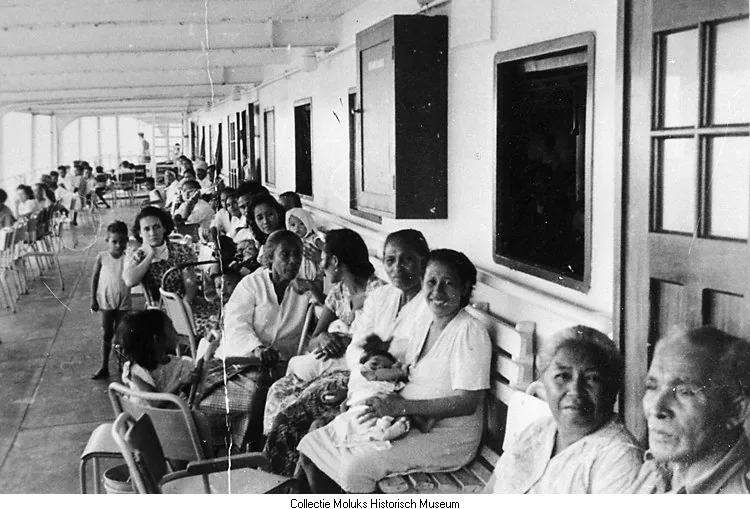
Arrival in Rotterdam On 11 May the Moluccan soldiers and their families were housed in the camps Overbroek near Kesteren (Gelderland) and Wite Pael near Sintjohannesga (Friesland). The 9 Moluccan navy men were taken in by the Navy. Former KNIL officer and liaison E.J. van Baarsel described the arrivals of the ships. In his report on the arrival of the Skaubryn we read:
"An Ambonese man was gazing in admiration at a brand-new Dutch paper guilder bearing the likeness of the Queen [Juliana, ed.], which he had just been given. When he saw me, he said: 'toewan ini betoel, tapi di Indonesia pakai rotkop Soekarno'." (trans.: "Sir, this one is right, but in Indonesia it has that rotten head of Soekarno on it")
Further reading:
a detailed description of the Skaubryn in Transportschepen, Nationaal Archief, The Hague
the passenger list in Molukkers naar Nederland, Nationaal Archief, The Hague
De Collectie vertelt… over de Skaubryn, with the story of the orphan boy Frans Hehanussa, on the old Museum Maluku website