This Rotterdammer has been working in the film world since 2010. His work revolves around visual storytelling, but anyone who talks with him soon discovers that his stories actually begin with something you cannot capture on camera: listening.
Once you are in conversation with Uriël, something quickly stands out. He listens attentively, looks carefully and takes his time to answer. Silences do not have to be filled straight away. And at the same time there is a great deal of laughter.
He himself says quite matter-of-factly that he does not really enjoy talking all that much. That he feels most at home behind the camera is perhaps not so strange, then.
As a child Uriël had a stammer. Little of it shows during the interview, but it has shaped how he deals with language and communication. When speaking does not always come easily, you start to think differently about words. About what they can do to someone, but also about how important it is to listen well.
You see that in his work too. Because in order to tell someone's story, you first have to be willing to listen to it.
His interest in film began early. As a boy Uriël watched a lot of films and productions and became fascinated by the way stories were told and built up. There were plenty of makers to watch and learn from. And yet something was missing.
He missed makers in whom he could also recognise himself culturally. Moluccan makers and storytellers who told stories from a background he knew himself.
At the same time it is striking that his own taste in film differs considerably from the work he has become known for. Ask him about his favourite genre and the answer is simple: horror.
Even so, in his own work he deliberately chooses to make room for Moluccan stories in the Netherlands.
That choice seems to have a lot to do with something he long missed himself: recognition. Not only seeing yourself reflected in a story, but also knowing that your story is worth telling.
The Moluccan story beyond 1951
That search also returns in Moluks in 2051, a project Uriël devised and curates. Many Moluccan stories in the Netherlands are about colonial history and the arrival of the first Moluccans in the Netherlands in 1951. That history is important, but Uriël is also curious about what comes after it.
What stories are Moluccan makers telling now? What role do culture, traditions and customs play in them? What do new generations carry with them, and what changes over time?
And above all: what does the Moluccan story look like in 2051, when Moluccans will have been in the Netherlands for a hundred years?
As curator, Uriël is responsible for the content of the programme. Different forms of media are used to tell stories. Not only to look back at what has been, but also to think about what may still come.
That forward look recurs often in his work.
Even when his films deal with heavy or sensitive subjects (as in Goldfish for Breakfast, which centres on grief), he does not dwell on the past alone. History and the pain that comes with it are given their place, but they are not the end point of the story.
There is still room for what comes after.
In the end, the gaze always turns forward again.
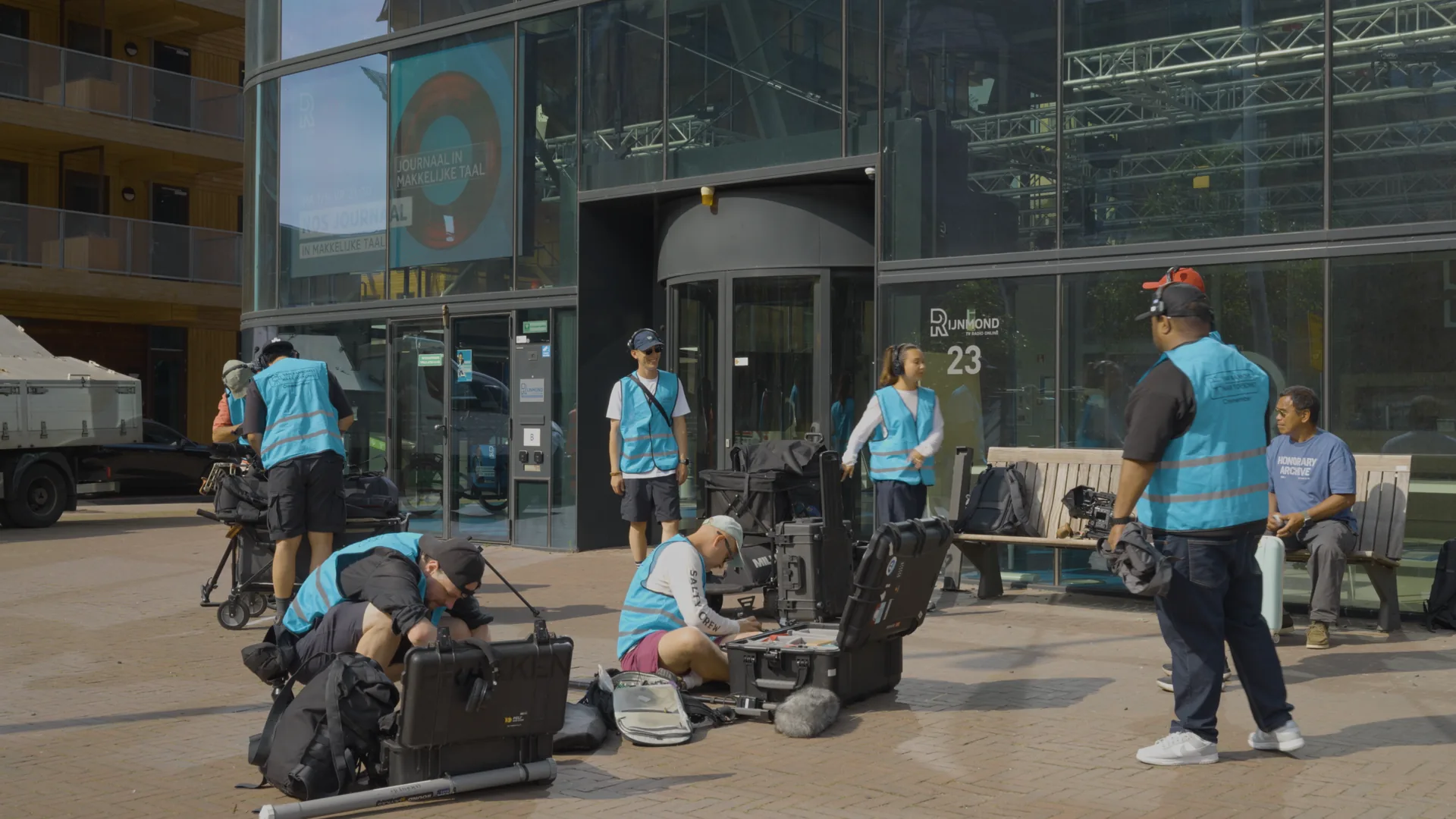
During the unveiling of Ulu Kora on 21 June 2026 at the Lloydkade in Rotterdam, the film crew works on the documentary Van aankomst naar toekomst.
From arrival to future
Uriël is currently working on the documentary Van Aankomst naar Toekomst (From Arrival to Future), in which Ulu Kora, among other things, has a place. The idea arose in May 2025, out of a feeling he could no longer ignore: this story had to be told.
Not only to look back, but precisely to find out what we carry with us. Which stories live on? What do we pass on to a next generation? And what risks being lost if nobody records it?
For the documentary Uriël works with a film crew made up largely of Moluccan makers. That makes the project personal. Not only for the people in front of the camera, but also for those behind it.
During our conversation it suddenly becomes clear how personal all of this is.
As Uriël talks about the stories he wants to record, he comes to his own family. To his grandparents. He falls silent.
The filmmaker who observes so carefully and chooses his words with such care is visibly moved. For a moment no fine sentences are needed. No explanation. His emotion says enough.
Perhaps that is exactly why this story has to be made.
Because history does not consist only of dates, events and archive footage. History lives in people. In memories that stay with you. In the stories of grandfathers and grandmothers. In what is passed on – sometimes in words, sometimes precisely in silence. And that emotion is allowed to be there.
Because being moved is not weakness. It means that something matters. That a story is not only something you tell, but something you carry with you.
That is perhaps also where Uriël's strength as a filmmaker lies. He does not look at other people's stories from a distance. He dares to come close. To listen. To feel. And to leave room for what cannot always be captured in words.
We are therefore proud to be able to work with Uriël and to see him grow in the creative field, and we are very much looking forward to the moment his documentary sees the light.
Van Aankomst naar Toekomst is more than a title.
It is a story about where we come from, what we carry with us and what we want to pass on.
And we cannot wait to see it.