In 2020 Statistics Netherlands (CBS) published the report 'Moluccans in the Netherlands. The socio-economic position of Moluccan migrants, their children and grandchildren'. That CBS report came as a surprise. The last major study of the socio-economic position of Moluccans had appeared in 2001: 'Molukse jongeren in Nederland. Integratie met de rem erop' by Justus Veenman. A few overviews and regional studies followed after that. But a broader overview seemed out of reach because Moluccans were 'statistically untraceable'.
So the CBS had found a 'back door', namely linking registrations on income, education and medicine use, among other things, to a list of Moluccan names from the population register, officially the Personal Records Database. They based that list of names on the ships' lists from 1951. Quite how they dealt with European-sounding names such as De Jong is not entirely clear. It must have been quite an exercise, but it is also slightly alarming that it can be done. If it is possible to search the population register by name and link the results to other registrations, then the government does have a great deal of detailed private information about us. Certainly with the childcare benefits scandal in mind, in which algorithms led to ethnic profiling, that can be worrying.
Back to the CBS report 'Molukkers in Nederland' (04-02-2021). What do the figures say? What lies behind them? And are they worrying? It is impossible to go into every figure. A few main points.
Numbers
Let us first look at the overall figures and at the definitions of generations that are used. Estimates of the size of the community fluctuated between 50,000 and 70,000 people. On the basis of the list of names, CBS calculated that the Moluccan population group consists of 71,000 people, regardless of whether both parents or only one is of Moluccan descent. According to CBS, 8,000 of the first Moluccan migrants were still alive in 2018. That sounds slightly odd when we consider how greatly the first generation, as we usually speak of it, has already thinned out. It can be counted on just a few hands.
"For CBS, the 'first generation' is everyone who was on board the ships. Including those aged 0 or 1."
The high CBS figure is a result of the definitions it uses. In most studies people speak of the first generation when they mean the adults in 1951 and of the second generation when they mean their children. The somewhat older children in 1951 are referred to as the bung and usi generation. CBS uses a statistical definition. Although it occasionally speaks of the 2nd and 3rd generation, it works with 'Moluccan migrants', their 'children' and their 'grandchildren'. For CBS the 'Moluccan migrants' are everyone who was on board the ships. So including those aged 0 or 1. Together with their older brothers and sisters and their parents, those babies make up the 'Moluccan migrants' or first generation. The CBS approach is understandable. The disadvantage is that Moluccans with widely differing experiences – for example those who went to primary school only at the end of the camp period, in the late 1970s – are treated as a single category.
Housing
It was often estimated that at least 60% of the Moluccan community lives outside the neighbourhood. CBS does not give a hard figure for who lives in the neighbourhood. It has been able to establish that 63% of Moluccans live in a 'Moluccan municipality'. That percentage is highest for the first generation and lowest for the third. Strikingly, more people with four Moluccan grandparents live in a 'Moluccan municipality' than Moluccans with fewer Moluccan forebears. A disclaimer is immediately in order here, incidentally. All the aunts who came over on the ships, 27.5% of whom were not Moluccan, are counted as Moluccan grandparents.
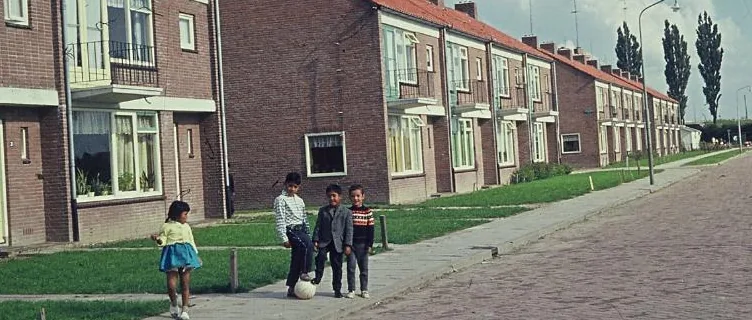
Museum Maluku collection (coll. J de Lima, photographer unknown)
Not all the figures CBS gives are genuinely meaningful. It calculates, for instance, that compared with the Moluccan population group (63%) only 35% of the Dutch population lives in a Moluccan municipality. With a comparison like that you can really only say something if you had looked at how many Dutch residents still live in the municipality where they were born. Equally uninformative is the calculation that Leerdam has proportionally the largest Moluccan population in the Netherlands. That only says something about the ratio between the number of Moluccan and non-Moluccan residents, and little about, say, the distribution of Moluccans across the Netherlands. As soon as Leerdam merges with another municipality, Leerdam could lose that 'top position' immediately.
Education
Until now the educational position of Moluccans has been a point of concern in much socio-economic research. In the 1990s Veenman reached hopeful conclusions. The second generation was catching up and it would be good if the third generation continued that. In 2001 he unfortunately had to conclude that the progress was not there. CBS comes to the same conclusion. Between 2013 and 2018, Moluccans less often obtained a basic qualification (at least MBO level 2), there was a high drop-out rate, and Moluccans attained a lower level of education than the Dutch population.
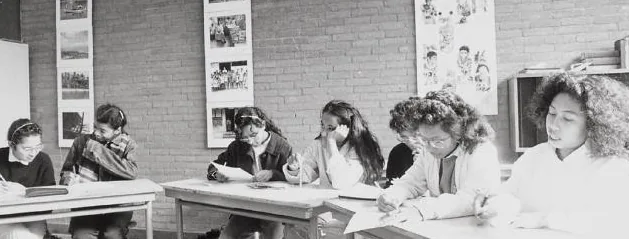
Photographer: O. Tatipikalawan (1985), Source: Museum Maluku
CBS also calculated whether the educational performance of Moluccans differed from that of Dutch people in a comparable starting position. A decomposition analysis, as it is elegantly called: comparing people whose parents have a comparable level of education, income and family situation. The differences are then a good deal smaller. On the one hand that is positive. It would have been serious if the differences had been large there too. On the other hand it is cause for pessimism, because it means that the disadvantage built up since arrival does not appear to be being made up.
"CBS neglects to mention that the low level of education is partly the result of the Dutch authorities referring most Moluccan pupils to lower vocational education in the early years."
There is, however, a striking omission ['negligence', ed.] in the CBS's background sketch of the educational position. It writes that the disadvantages were persistent and were partly caused by the parents' low level of education. According to CBS, Dutch policy in the early days was aimed at giving Moluccans as much Dutch education as possible. What it neglects to mention is that in those early years most Moluccan pupils were referred by the Dutch authorities to lower vocational education. Boys to the Lower Technical School and girls to the domestic science school.
Work
The CBS account of the position of Moluccans in the field of work follows a similar course to that of education. Earlier studies already showed that labour participation among Moluccans was lower than among Dutch people. Moluccans start working earlier, reach lower wages and more often work through employment agencies, which gives them a vulnerable position in the labour market. The differences are not large, however, and fluctuate by category. Moluccans aged 65 to 75 work slightly more than Dutch people. And compared with Dutch women, Moluccan women somewhat more often work full-time. But why that is cannot be read from the figures.
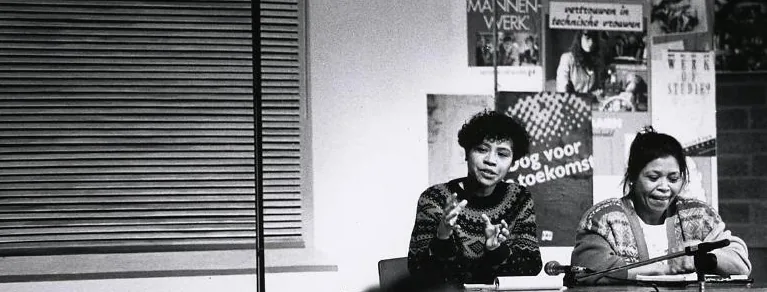
O. Tatipikalawan (1990), Source: Museum Maluku
And again, when the comparison is with a socio-economically comparable group of Dutch people (the decomposition analysis), the differences turn out to be a good deal smaller. They become almost minimal. The 'children of the migrants' (second generation) then do better, while the 'grandchildren' in fact do worse than Dutch people. So once again we can conclude that the existing disadvantage is not being made up, because on average the Moluccan population group remains stuck where work is concerned.
Youth care, youth support and crime
Earlier studies did not pay separate attention to the position of Moluccans in relation to youth care and crime. CBS apparently also had access to registers on child protection, youth care and suspects of criminal offences.
In 2018 Moluccan young people received slightly less youth support (support for the young person) than Dutch young people. According to CBS, young people with more Moluccan grandparents received less youth support than young people with fewer Moluccan grandparents. That may point to support from within the community. But on the basis of the figures alone that cannot be said with certainty.
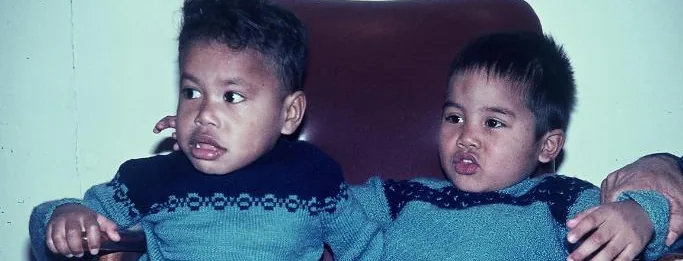
Museum Maluku collection
For child protection (intervention from outside for the safety of the young person) the figures were different. There, Moluccan young people scored one and a half times higher than Dutch young people. Why that was cannot be read from the figures.
For figures on Moluccans suspected of a criminal offence, CBS used registrations between 2014 and 2018. These showed that people with a Moluccan background were suspected of a criminal offence almost twice as often as people with a Dutch background (10.7 and 6.2% respectively). Compared with Dutch women, Moluccan women were slightly more often suspected of crime and, not unexpectedly but as a regular pattern, young people were suspected more often than older people.
The problem with all these analyses is that numbers say little. What are they suspected of? Violence? Financial offences? For crime too, CBS carried out a decomposition analysis. It could not explain the differences, however.
Health
The last domain CBS studied is health, albeit in limited form. In terms of medicine use, only antidepressants, antipsychotics and medicines against obesity were compared, and the healthcare costs of Moluccans were examined. Moluccans pay lower healthcare costs because they are on average younger, they take fewer antipsychotics, but they do take twice as many diabetes medicines. The latter is worrying, because it has to do with eating patterns and exercise.
In itself a 'decomposition analysis' would have been in order here, because obesity can be connected to people's socio-economic position. Unfortunately CBS leaves us in the lurch on this point. Possibly no link may be made between the population register and medicine use for reasons of privacy.
That does raise the question of why the chapter on health, and possibly 'youth care' as well, was included in the CBS report. If it cannot be compared on an equal footing with education and work, what is the added value?
Should we be worried?
So what does the CBS report mean? What do the figures say, and are they worrying or not? It is time to take stock. It is good that there are now reliable figures on the number of Moluccans in the Netherlands and how many Moluccans still live in the Moluccan municipalities.
The figures on educational and labour position give pause for thought. It appears that neither position has changed in the past 20 years. The decomposition analysis (comparing with Dutch people in the same starting position) shows that the positions of Moluccans resemble the Dutch ones, which seems positive. But it also means that the Moluccan population group as a whole still faces disadvantage in terms of participation in education and work. What the figures do not show is why. What do Moluccans run up against? There are certainly Moluccans who managed to reach better positions. What routes did they take? Unfortunately the figures give no answer to that. Qualitative research would be needed for that.
"The why and how questions surface immediately with figures on youth support and suspicion of criminal offences."
The same applies to the differences CBS sometimes sees between Moluccans with four or fewer Moluccan grandparents, as with youth support. Is there a relationship, and how does it work? The same story applies to figures on medicine use. Why fewer antipsychotics, for instance? Does that have to do with mutual support? And that high figure for diabetes medicines? Why?
The why and how questions also surface immediately with the figures on suspicion of criminal offences. Why is it so high? Might it have played a part that between 2014 and 2018 the Public Prosecution Service was investigating the motorcycle club Satudarah with a view to banning it, putting the combination of Moluccans and crime under the magnifying glass for a while? Or did the conflicts in several Moluccan neighbourhoods over the allocation of empty houses, in which a stone went through a window or a house was daubed, contribute to it? Questions of this kind can only be answered if the figures are given more substance.
"The figures point to concerns in the areas of welfare, health and crime but do not say why."
The CBS report, which has, so to speak, brought the Moluccan population group a little out of the statistical shadows, has above all an alerting value. It tells us that the socio-economic disadvantage that existed is being made up only very slowly. But it does not show us why. The figures also point to concerns in the areas of welfare, health and crime. But they do not say what the real problems are, what lies behind them, and therefore not how things can be improved either. In that sense the report calls for qualitative follow-up research.
*This article appears simultaneously in Marinjo magazine