On 29 April 1951 the 5th transport carrying Moluccan ex-KNIL soldiers and their families arrived in the port of Amsterdam. The New Australia had left the IJmuidenkade in the port of Surabaya on 7 April. On board were 497 KL soldiers and 1,083 Moluccan ex-KNIL soldiers with their families. Captain D. Aitchinson was at the helm of this English ship.**
The SS New Australia was built in 1931 as a luxury passenger ship at the Vickers-Armstrong Shipbuilders Ltd. yard near Newcastle-upon-Tyne (UK). The client was the English shipping company Furness, Withy and Co. Under the name Monarch of Bermuda she sailed as a cruise ship between New York and Bermuda until 1939. Shortly after the outbreak of the Second World War she was converted into a troop transport ship and deployed in various convoys. After the war the British government bought the ship and had it extensively converted into an emigrant ship for 1,600 passengers. Under the new name New Australia it carried emigrants to Australia.
On two of her return voyages to Europe the New Australia picked up passengers on Java. The first transport left on 5 October 1950 with 1,603 repatriates from Tanjung Priok to Rotterdam. On 7 April 1951 a second transport followed of 497 KL soldiers and 1,083 Moluccan soldiers with their families. The New Australia sailed until 1966, in her final years under the name Arkadia for the Greek Line. You can read more about the history of the New Australia on the MHM website in the section "de Collectie vertelt… over de New Australia".
First transport, 5 October 1950
The Balk family travelled on the first transport on 5 October 1950. Father P. Balk, mother W. Balk – v.d. Zijl and their 6 children, among them the daughters Sonja, Yvonne and Astrid. After arriving in the Netherlands the family was housed in the D.U.W. camp 'De Haar' near Randwijk in the municipality of Heteren in the Betuwe. Daughter Sonja: "In green wooden barracks with pot-bellied stoves. There the mothers learned how to light the stove with peat and egg-shaped coal, and in the communal kitchen the mothers learned to cook Dutch food." In May 1954 the first Moluccans came to live in camp De Haar.
Second transport, 7 April 1951
1,083 Moluccan passengers embarked on the New Australia on 6 and 7 April 1951. 587 men, 495 women and 1 whose sex is unknown. You can find the names of passengers yourself on the website 'Aankomst van Molukkers' of the Nationaal Archief.
In the series "Twelve voyages, twelve stories", in 2016 the MHM published the fine story of Hanoch Marwa, who made the crossing on the New Australia with his wife and 4 sons. Son Eddy Marwa looked back on it at the time.
Source: delpher.nl
The crossing from the Indies by the Moluccan soldiers and their families in the spring of 1951 is well documented. Countless reports about it appeared in newspapers in the Netherlands and in Indonesia. These newspaper reports can now be found online at www.delpher.nl, the database of the Koninklijke Bibliotheek in The Hague. More than 300 articles deal with the crossing on the New Australia.
We give a few examples here:
Algemeen Handelsblad, 1 March 1951
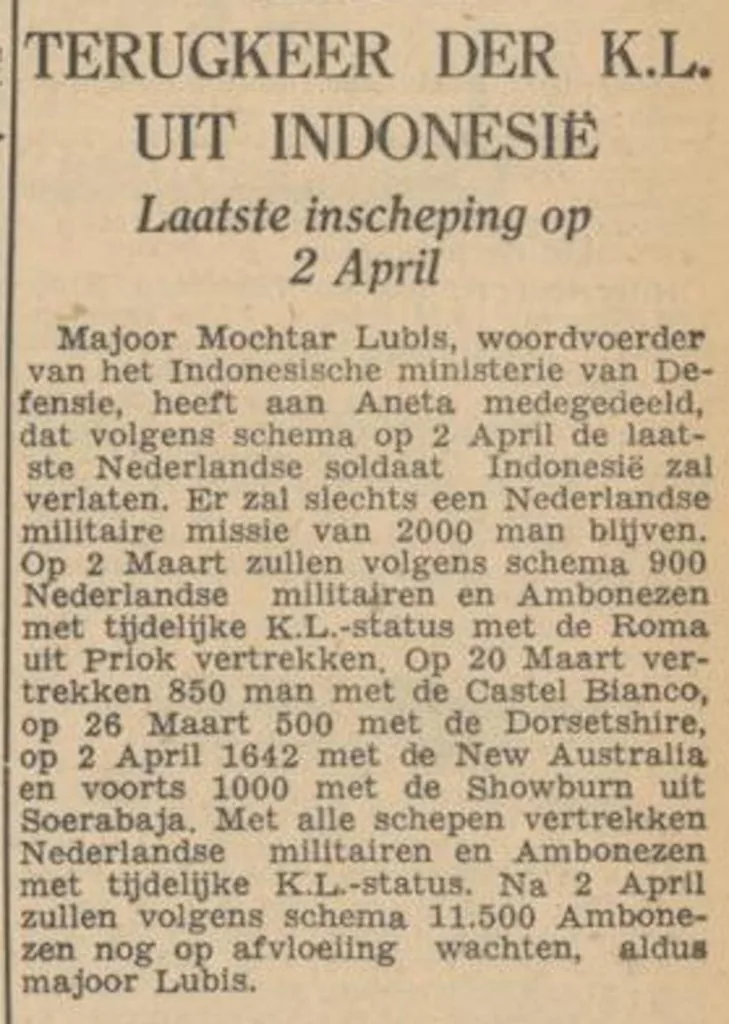
Major Mochtar Lubis, spokesman for the Indonesian Ministry of Defence, told Aneta that the last Dutch soldier would leave Indonesia on 2 April. On 1 March 1950 virtually every newspaper in the Netherlands reported the news. (Source www.delpher.nl)
De Vrije Pers, 6 April 1951
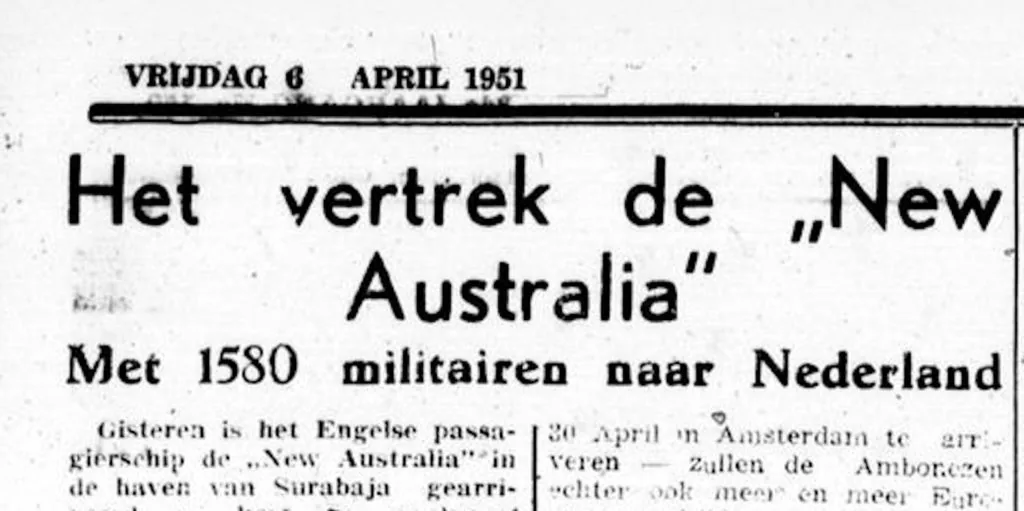
(Source www.delpher.nl)
Nieuwe Courant, 6 April 1951
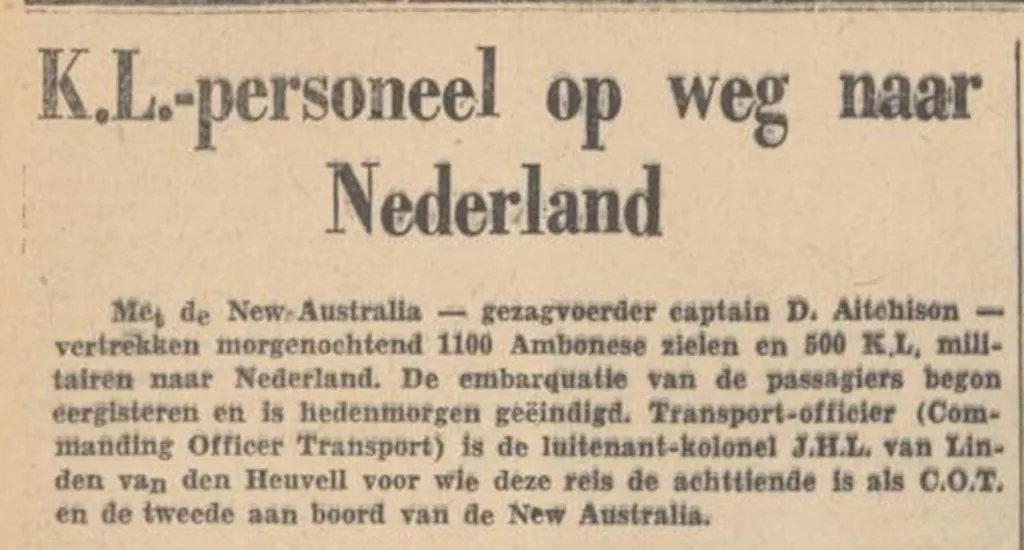
(Source www.delpher.nl)
The newspaper article 'K.L. personnel on their way to the Netherlands' in the "Nieuwe Courant" of 6 April 1951 describes the ship and the coming departure with the Moluccan passengers.
"On board we saw a swimming pool and a cinema, splendidly appointed smoking lounges, a bar, a shopping arcade and of course a hospital. But no maternity facility, because no children may be born on board the New Australia. Women who are heavily pregnant have to wait for a later ship, because they cannot be helped on board this one."
On the meals we read: "The former K.N.I.L. members and their families will gradually be switched over to the European menu on board. The intention is to serve only rijsttafel during the first week. In the second week the menu will be alternated with potatoes, meat and vegetables, and in the third week only European fare will be served."
The English cooks on board were, incidentally, instructed in the 'rijsttafel' by 3 Moluccan soldiers.
Nieuwsblad van het Zuiden, 29 April 1951
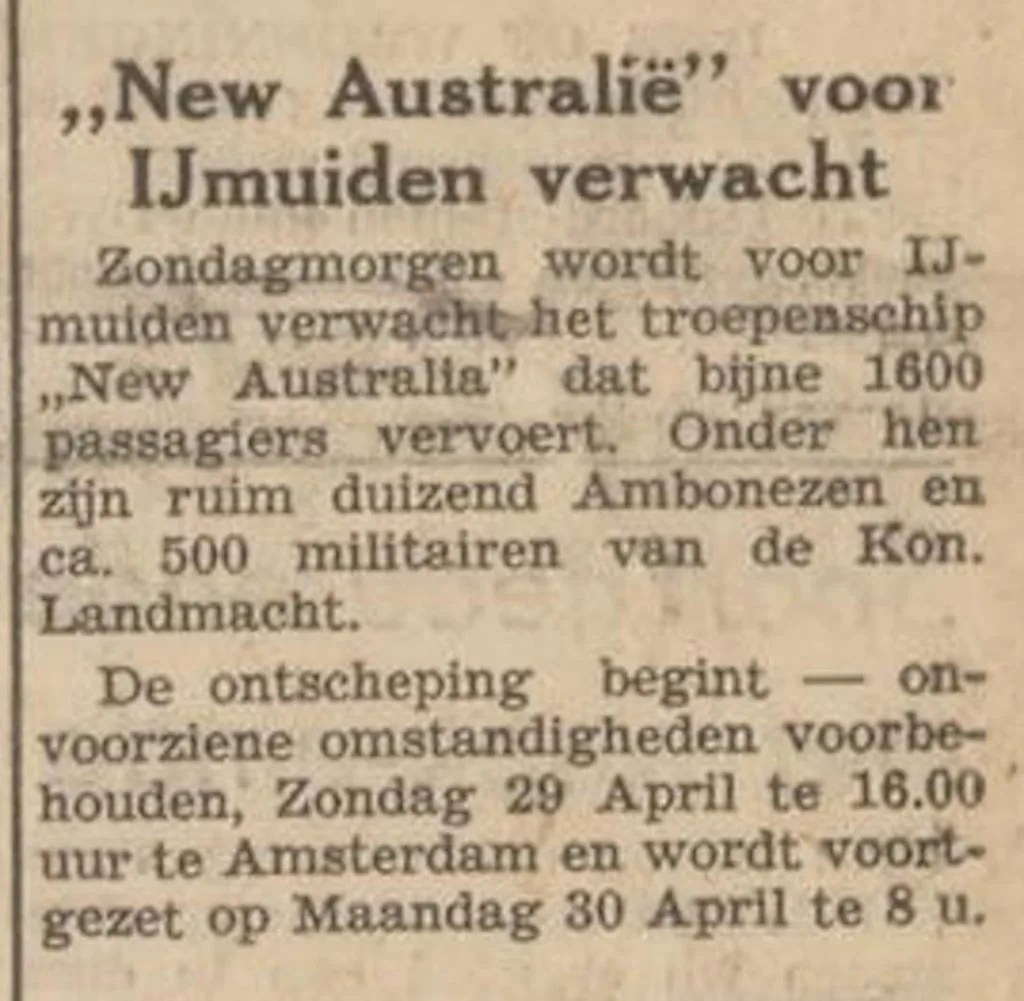
(Source www.delpher.nl)
On 29 April the New Australia arrived in Amsterdam and moored at the Javakade. Disembarkation followed early the next morning, via camp Amersfoort. Buses then took people to various camps: Rodanborgh in Aardenburg, Graetheide in Geleen, Tungelroy, de Schaffelaar and de Biezen in Barneveld, Geesbrug, Stuifzand near Ruinen and Heythuysen. Single men found accommodation in the bachelor or boedjang camps Eind van 't Diep and – how fitting – Pikbroek near Steenwijk.