Column by Joaniek Vreeswijk
It can be said that we are currently living through a groundbreaking period. At the very least, 2020 will probably go down in the history books as a year in which the world was turned upside down. The year in which COVID-19 drastically affected our lives because of the danger this virus poses. And also the year in which, following the death of George Floyd, the Black Lives Matter movement grew into a worldwide phenomenon and became the largest movement ever in the United States. A year in which the decolonisation of our present-day thinking came fully into focus again through the Black Lives Matter movement. The year in which young Moluccans, in the context of decolonisation, protested against the statue of J.P. Coen in Hoorn.
What has been happening around us these past months is no small thing. All kinds of things are happening in our Moluccan community too. Many initiatives have recently got off the ground from within our community: on the struggle for a free RMS, on connection between the different generations, on our support for the Black Lives Matter movement, on the empowerment of the third and fourth generations, on projects in cooperation with our bangsa in Maluku and on spreading knowledge about our Moluccan culture and identity. Those are fine developments to see, and some of the aims often overlap. That offers hope and perspective for the future.
New life in existing initiatives
We also see existing initiatives being given new life: Moluccan dialogues about themes that are current are encouraged through gatherings where the third and fourth generations can make their critical voices heard. In that way we follow in the footsteps of those who went before us. Moluccan organisations in the 1970s and 1980s also organised national gatherings, as did those in the 1990s when the oldest of the third generation were active in national organisations. It is good that we are now taking over part of that baton, because at the moment the feeling among young people of wanting to do something and contribute seems to keep growing. It is important, of course, that we enter into dialogue about this with the generations before us. In the end we need the whole community if we want to contribute something concrete for our Moluccan community here in the Netherlands and in Maluku.
It is good that we are now taking over part of that baton
Following the flag actions, many young people have started thinking: what do I contribute, or what can I contribute, to the struggle for a free Maluku? Or what do I contribute, or what can I contribute, to a better Maluku for our bangsa in tanah air? In addition, following the Black Lives Matter demonstrations and protests in the United States, many young people have begun asking themselves: what can I do to support the Black community in their struggle and how can I show my solidarity with them? How can I make sure that my bangsa in my immediate circle see that they should not close their eyes to this? Not only because it is in the first place about empathy for a fellow human being who is not currently treated equally, but also because the Moluccan community likewise knows a history of oppression by a colonial occupier. Both racism in all its facets and the oppression of our Moluccan forebears come from two nests: our history of slavery and our colonial past.
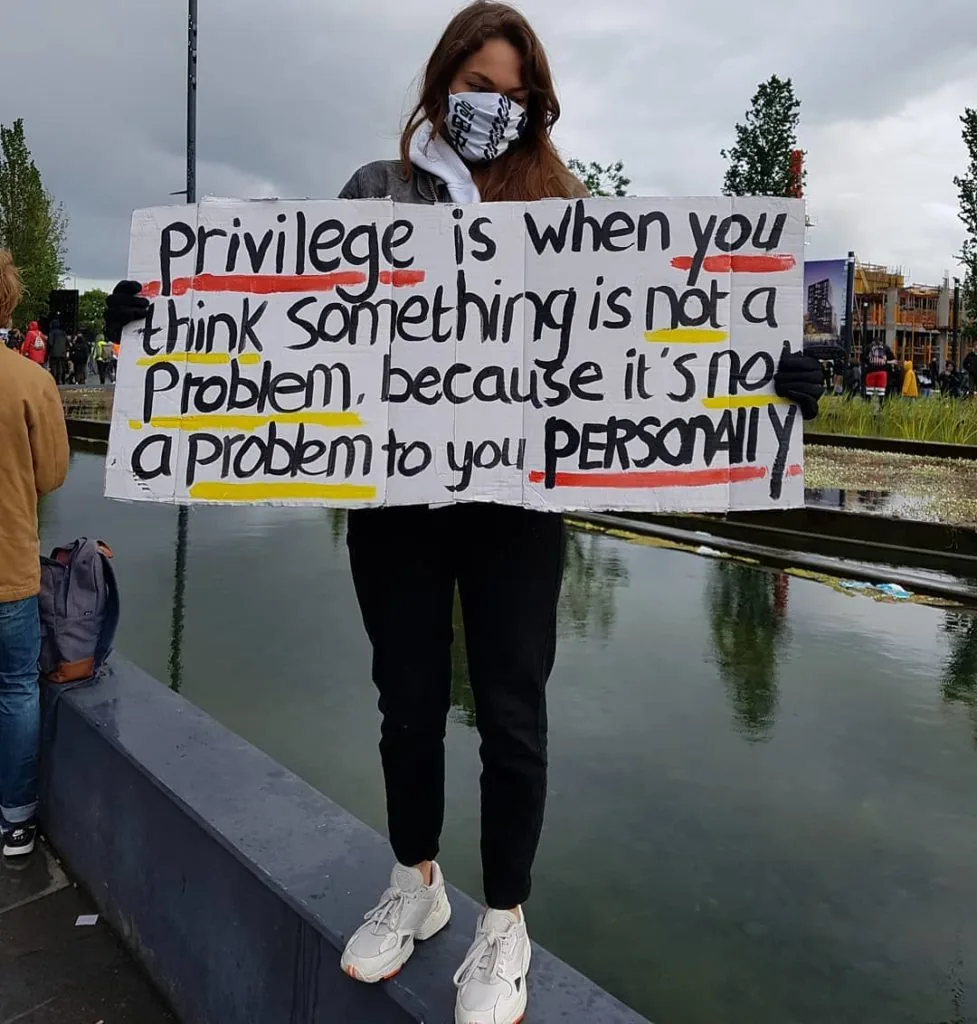
At a BLM demonstration in Utrecht
Divide and rule is what lies behind it. That has always been a tactic of imperial and colonial rulers. Set groups against one another and in that way you keep power, because the oppressed cannot then form a single front. In that respect I see similarities… higher powers holding the strings by playing groups off against each other. Unfortunately that is not only something of the past, but certainly of the present too. Look at the Netherlands with its colonial hangover, look at the US with its hangover from the history of slavery and look at Indonesia with its neocolonial traits. Of course there are essential differences, but I do also genuinely see the points of contact. Had the Netherlands supported the federal state of Indonesia (RIS) at the time, or perhaps even the RMS? Then our people there might not be oppressed now. My point: much of the problematic that is playing out now has its origins in the colonial past and the history of slavery, and in how the imperial and colonial ruler deployed its politics of divide and rule.
Solidarity with BLM
Some Moluccans do not see the need to be in solidarity with Black Lives Matter. And as a historian I cannot understand that thinking myself, but I can understand where it comes from. Many Moluccans do not feel connected to other migrant groups, because Moluccan soldiers formed an important pillar of the former Royal Netherlands East Indies Army (KNIL). Their arrival in the Netherlands in 1951 was the dramatic consequence of a thorny situation that arose after Indonesia had fought itself free and the Netherlands, after much international pressure, had to let the colony go. Their passage to the Netherlands was not voluntary. Moreover, many were dismissed on arrival in the Netherlands. We all know what followed. The wooden camps… the move to the neighbourhoods… My grandmother was going to stay here for six months at most… next year she will have been living in this country for 70 years. When she boarded the Kota Inten as a seventeen-year-old girl she could of course never have predicted that!
That does not mean, however, that because of our unique migration history we have reason to look away from racism in all its forms and sizes. To quote the Black Renaissance Collective: "Racism is not an opinion but a murderous system that has systematically exploited, excluded and oppressed Black people for centuries and has caused generational traumas." In the present era, through digitisation and globalisation, we have the privilege of informing ourselves endlessly, of continuing to learn, of contributing at a distance, of committing ourselves to what we believe makes the world a little better. There is a beginning! Change does not come about overnight. That takes staying power, but we have it. The start has been made. Now we have to push on. Maju terus! Jangan unduré!
This column appeared on 13 July 2020 on the Facebook page of Maluku Utrecht. Joaniek Vreeswijk is a historian and MHM republishes this piece with the author's permission.