Observations in Ambon
On the way from the airport to the hotel the driver told me that the hotel has been very full lately. Mainly with Moluccans from the Netherlands, 'Maluku-Belanda'. They usually come from the beginning of October and that lasts until January, after which it quietens down. It is a kind of Maluku-Belanda season. "And this year there are more than last year," he said. A friend who is a hotel manager in Ambon confirms it: this year there are more Moluccans from the Netherlands than in other years. The hotel's occupancy certainly bears that out.
Two years ago I stayed here for the first time. The hotel had just opened then and there were few Moluccan Dutch guests. Back then most people came from the city to try out the restaurant on the top floor of the hotel, the new spot with a view over Karang Panjang and the statue of Martha Christina Tiahahu. Now the great majority are Moluccan Dutch people and their families. At my first breakfast I already run into two comrades from Amsterdam who have just arrived. And there are more, as it turns out over the following days. I had also noticed that the hotel now advertises that Dutch is spoken here.
-
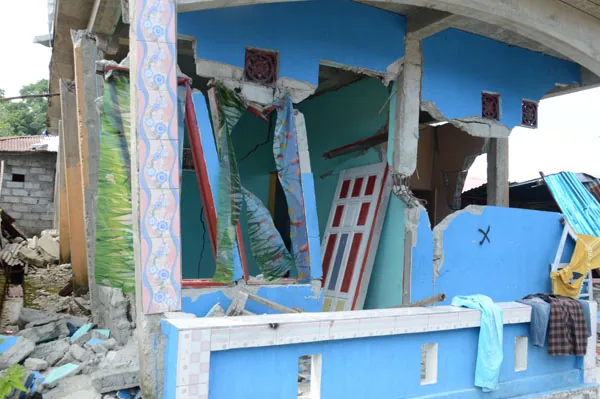
House in Waai
-
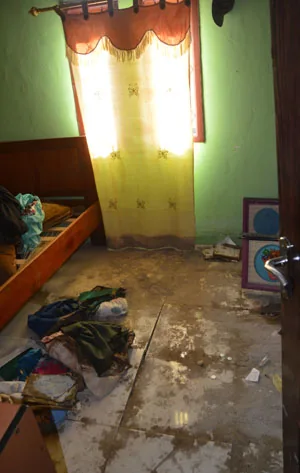
Bedroom
-
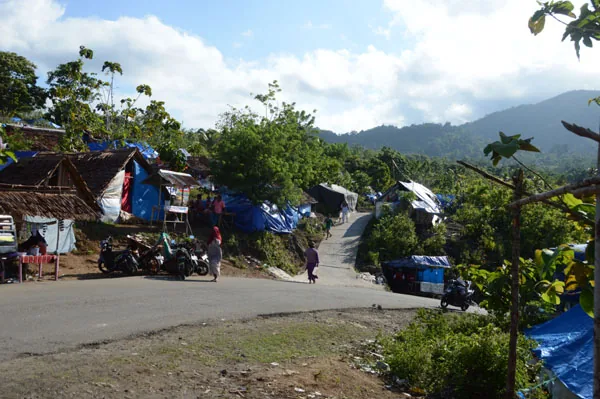
Evacuees, Liang
During the day the restaurant sometimes looks like an office with flexible workspaces. Moluccans from the Netherlands sit scattered at the tables talking with guests. When the guest or guests leave, they shift in their seats, check their phones or relax for a moment. Then new guests arrive, hands are shaken, there are embraces and people sit down again. More cups of coffee, tea or juice are ordered, and perhaps a dish of pisang goreng. Then the conversations begin again. Some talk mainly about how the family is doing, who has died and who has married and what the new baby is called. Others are busy gathering information about family history, or about the history of the village. At some tables gifts are exchanged too. Next to me someone slides his sunglasses over to a relative. His Dutch partner takes her own sunglasses, removes them from the Ray-Ban case and hands over the case for the new acquisition.
The earthquake in September is not the reason so many Moluccan Dutch people are in Maluku now. But it helps. The earthquake brings Moluccans from the Netherlands closer to Moluccans in the Moluccas. People who happened to be present when the earthquake struck set up all kinds of projects. I hear of a young third-generation woman who spontaneously starts crowdfunding for her village. In no time she has raised 6,500 euros. Too little, because in her father's village, where people have fled into the mountains, health is at risk. Others help distribute aid brought in from the Netherlands.
Of course there are differences of opinion about what is wise and who can be trusted. Is it best to give aid through established organisations such as TitanE or rather through individuals? The response to this disaster is no different from usual: private initiatives criticise the existing organisations, and nobody really knows what is best. There is discussion about what should be done: emergency aid or helping to restore the infrastructure? And where should it be restored? Residents of some villages are so afraid of new tremors and possibly a tsunami afterwards that they would rather build a new village in the mountains. In Passo people prefer to sleep outside in tents on the central reservation of the higher-lying main road. What is or is not useful is hard to say if you have not seen the situation on the ground and heard from people what their experience is.
As I drive through Waai and Liang I am struck by the devastation. Waai is silent, a deserted village where normally people, dogs, cats and chickens should be moving about. Now I see only a few inhabitants here and there, mainly men. Liang has been badly hit too. A little boy invites us to look at one of the bedrooms in his house. There, for a whole day after the quake, smoke and mud came up between the floor tiles. Caked mud on the ground and shifted tiles are the silent witnesses of this nightmare. A neighbour takes us out of the house; you never know what may happen. Perhaps a large hole has opened up under the floor of the room, as on the other side of the road.
On the back of a motorbike another neighbour takes me up the mountain above Liang, where people have fled. It looks like a village three kilometres long, all blue tents, a temporary school, a mosque, toilets. The bus from Ambon to Liang has its terminus here too. As if a few diversions have simply been made to the route. People are still frightened and have traumas, says the neighbour who drives me around. People do not trust the water supplied to them by the government and use it only for washing. Where is the aid coming from, I ask, when I see a banner of the NU, Nahdlatul Ulama, an Islamic organisation. From seven organisations, he says. Not from the Netherlands? No, not as far as he knows. Perhaps fewer people from Liang live in the Netherlands, he thinks. His grandfather had gone to the Netherlands with the KNIL but had already returned to the Moluccas in 1960.
In times of disaster, the relationship between Maluku and Moluccans in the Netherlands comes under high tension again. In both a positive and a negative sense. Negative because of the bickering among themselves. Positive because of the concrete help people can offer and the possibility of supporting people in the Moluccas from the Netherlands. Involuntarily I have found myself thinking back lately to the kerusuhan between 1999 and 2003. There was the same high tension in the relationship then. The big difference is that this time there is less powerlessness. How to help in a natural disaster is more obvious than in a conflict.
Photos: Fridus Steijlen
#
Latest posts
#
Search the image archive yourself
#
Visit 'Vechten voor vrijheid. De vele gezichten van verzet'
#
[
](https://www.museum-maluku.nl/exposities/actuele-tentoonstelling/)