At 9.00 in the morning on Tuesday 15 May 1951 the Somersetshire arrived in the port of Amsterdam. It was the 8th transport carrying Moluccan ex-KNIL soldiers and their families from Indonesia. Disembarkation followed at 10.00. Privates 2nd class Jan Rorafui from Aru and Marcus Uwuratuw from Tanimbar were on board, as were 3 newborn babies.
Earlier, on 10 April 1951, the Somersetshire had left Surabaya with 560 Moluccans on board. They had gone aboard that morning, 266 of them children. Three more children arrived in Amsterdam than had embarked.
Between Port Said and Amsterdam, after all, a girl and 2 boys were born. The girl was called Geronica Christina Patty. The boys were called Gerard Melchisedek Lalin and Thomas Somersetshire Surewene.
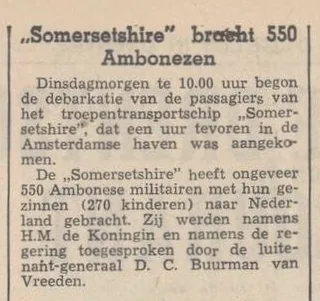
Provinciale Drentsche en Asser Courant, 16 May 1951
Somersetshire Built in Belfast in 1921, the Somersetshire was converted into an emigrant ship in 1948 and sailed between Australia and Europe. In 1950 and 1951 she carried out 4 troop transports bringing soldiers to the Netherlands.
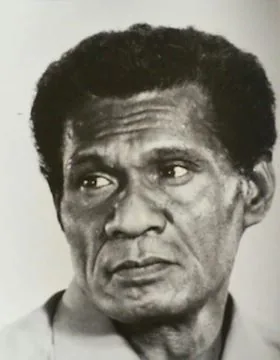
Jan Rorafui (1925-13 November 1990†)
Jan Rorafui (1925 – 13 Nov. 1990 †)** Jan Rorafui came from the village of Hokmar on the island of Aru. He was born in 1925, the youngest child in a family with 4 brothers and 1 sister. His exact date of birth is not known. The passenger list records 25 February 1925.
"But the family always celebrated Jan's birthday on 10 June," says his wife Klaske Rorafui – van der Loon from Drachten in Friesland. "He lost his father at a young age, and while he was living with a host family during primary school in Dobo (Aru), his mother died as well."
After the Japanese invasion in 1942, Jan fled into the jungle. Not much is known about how he came to join the KNIL as a private 2nd class. "He never spoke about it. All I know is that he drove trucks and that he came to the Netherlands on the Somersetshire and then went to live in the Schattenberg camp."
There he became friends with two other former soldiers from Aru: Max Djilarpoin and Noes Goergoerem. He lodged with the Goergarem family, first in Schattenberg and later in Assen as well. In 1966 Jan went to work at Philips in Drachten. Assembling electric shavers.
"We married in 1968," says mem Klaske. Laughing, she tells how a few years earlier, during the TT night in Assen, her husband went to a fortune teller. And she predicted: "You will marry a woman from the North!" And so it came to pass. Jan from Hokmar on Aru became heit to 2 sons in Drachten, Friesland.
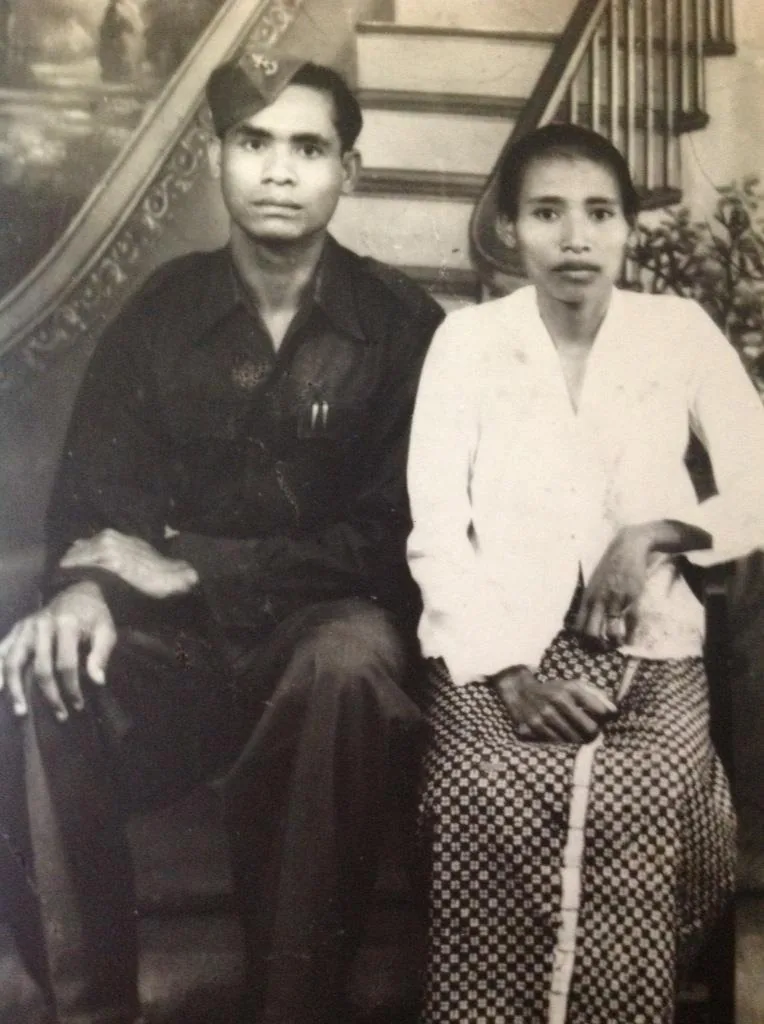
private 2nd class Marcus Uwuratuw with his wife Dorsila Uwuratuw – Luturmasse
**Marcus Uwuratuw (7 Feb. 1921 – 31 May 1994†) Private 2nd class Marcus Uwuratuw came from the village of Adaut on the island of Pulau Selaru (Tanimbar). He was married to Dorsila Luturmasse, from the same village, who was born on 24 March 1924. On 10 November 1942 their son Gijsbert Martinus Ibe, known as Dion, was born, shortly after the Japanese invasion of the Dutch East Indies.
"Pa said little about the war years or about the years as a KNIL soldier that followed," says Thijs Uwuratuw, the youngest of seven in the Uwuratuw family. "What we do know is that Pa was stationed in Surabaya and boarded the Somersetshire there with Ma and eldest brother Dion."
After arriving in the Netherlands the family was housed in Lunetten, camp Vught. "My five sisters and I were born in the Netherlands. Around 1956 we moved to camp Coehoorn near Muiderberg and in 1958 to camp Golflinks near Arnhem," Thijs says.
"In the end we moved to the neighbourhood in Zevenaar. My parents lived there until they died."
Further reading:
a detailed description of the Somersetshire, see 'transportschepen', website of the Nationaal Archief, The Hague
Somersetshire passenger list, see 'Molukkers naar Nederland', website of the Nationaal Archief, The Hague
"De Collectie vertelt… over de Somersetshire", old Museum Maluku website
Personal account by Mrs Ietje Ampak, old Museum Maluku website