This dataset shapes our surroundings, our view of the world and, perhaps even more importantly, the way we make choices.
Moluccans often carry a deep-rooted sense of pride and loyalty. But what does it actually mean to be Moluccan? What makes us Moluccan? How have historical events influenced Moluccans as individuals and as a collective? Does it make a difference whether you grew up inside or outside the neighbourhood? Whether your parents were part of the shared arrival in the Netherlands, or came later in the 1970s or 1980s? Whether you grew up in a former camp such as Schattenberg, Lunetten or Wyldemerk, or in the heart of Amsterdam in the 1990s?
These questions form the basis of Tatiana Wenno's book.
Generations communicating without speaking
Tatiana Wenno is a transgenerational regression therapist. Through her practice Touch of Fierce she guides clients in strengthening their sense of ownership and awareness. On 16 June 2026 she launched her first book: Het verhaal van jouw DNA (The story of your DNA).
Her healthy curiosity and genuine interest in people laid the foundation for her later work early on. Asking further, listening and trying to understand what moves people are qualities that have marked her since her youth.
She says herself, laughing, that her love of people, "though not all of them, of course", is the reason she likes to put people in their own strength.
"I do not help anyone," she says. "People become aware of something or run into something and cannot work it out on their own. I mirror, ask questions and offer tools. In the end they do the work themselves."
In 2021 Tatiana worked as a regional manager in business. There she noticed that colleagues easily took her into their confidence and that her words often landed. From that experience she found her way into the world of coaching. Her need for greater depth soon grew, however, which led her to retrain as a therapist.
Her research began in 2022. She conducted sixty in-depth interviews with Moluccans from the second to the fourth generation. These conversations, combined with her practical experience, formed the basis for her book.
According to Tatiana her book is not a replacement for therapy. She prefers to describe it as a loving embrace and a source of recognition. Whether you are a full-blooded Moluccan woman in your mid-thirties or a mixed-heritage Moluccan man in your late fifties: many experiences turn out to be surprisingly recognisable.
The central premise of her book is that generations sometimes seem to communicate without words.
According to Tatiana, upbringing has a great influence on how loyalty to parents, family members and friends is passed on. That works through on an individual level, but within the collective too.
To explain this she uses a metaphor from the IT world: that of the administrator and the user.
Administrator versus user:
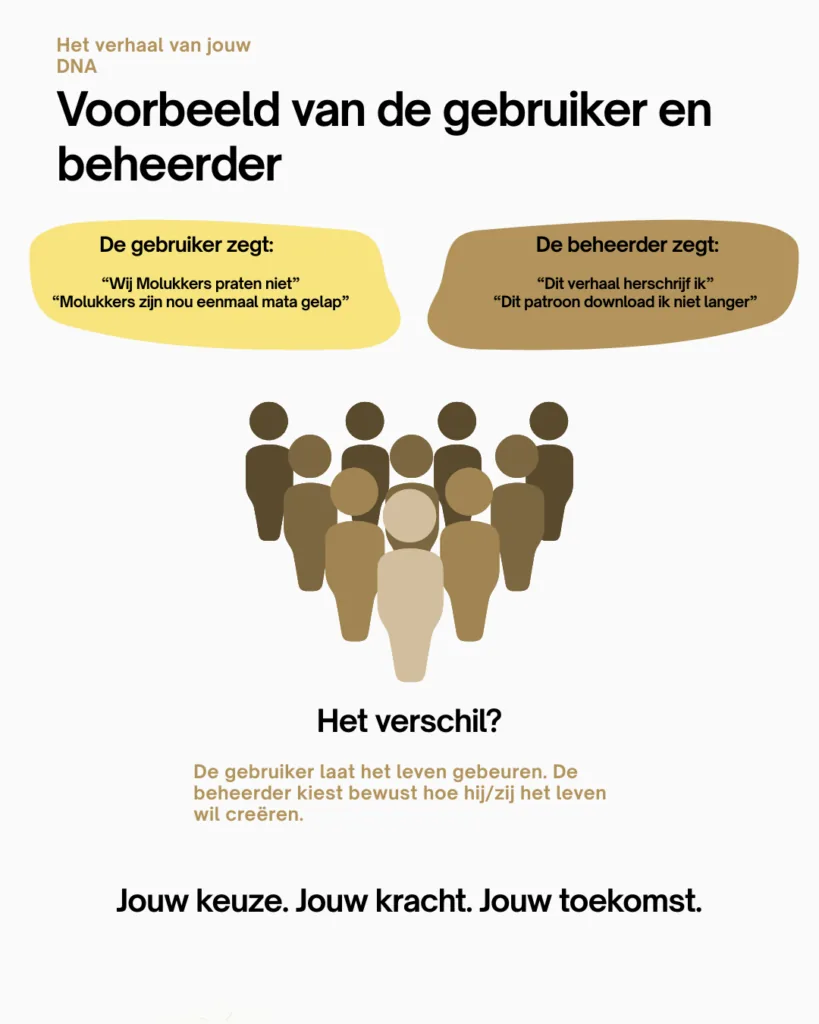
Imagine a grandparent (the administrator) carrying a secret. That grandparent's child senses that something is going on, but cannot name it. The feeling remains present, but is not discussed or processed.
Then a grandchild grows up (the user). The grandchild feels the tension or energy that is present and begins to react to it. Perhaps that shows itself in anger, sadness or restlessness. During a process of becoming aware, the grandchild slowly discovers which emotions are their own and which may come from earlier generations.
"You learn to distinguish what is yours and what belongs to someone else," Tatiana explains.
At first you are unconsciously incompetent. You do not yet have the right tools or insights. Until the familiar 'aha moment' arrives. Slowly you begin to peel away the different layers and room for understanding emerges.
According to Tatiana that is in essence what generational transmission involves.
Mata Gelap: the collective shadow
At the book launch Tatiana reads a passage from chapter 4.1: Mata Gelap – the collective shadow cloud.
"Mata means eye. Gelap means dark. They are two separate words you can use in different contexts. For example mata sakit (pain in the eye) or gelap di sini (it is dark here). Put these words together and you get the concept mata gelap.
Loosely translated this means seeing black before your eyes. A state of anger, rage or fury in which someone acts instinctively."
When I ask her which tool she would recommend first when it comes to the phenomenon of mata gelap, she closes her eyes for a moment.
Then a smile appears.
"I know."
With full conviction she says:
"Behaviour is what you do, not who you are."
And yet within the community we regularly hear statements such as: "Moluccans are just mata gelap."
According to Tatiana there is a risk in that. Such a statement suggests that it is a fixed part of someone's identity, while behaviour is precisely what can change.
In her book she describes, for instance, a mixed-heritage Moluccan man in his early forties whose father used to say:
"Can't you handle it? Pick up a brick and throw."
Within that context you see the challenges of a father trying to guide his son with the tools he himself has at his disposal. Not out of ill will, but out of love and out of his own experiences and frame of reference.
Working with cultural sensitivity
During her research the need for processing and awareness was confirmed again and again by her respondents.
At the same time Tatiana stresses that this work calls for sensitivity.
"Culturally sensitive" has become a popular term these days. In her view, however, it often stops at good intentions.
"We gather all kinds of different backgrounds so that we look inclusive," she says. "But then you do not always see that reflected in the culture of an organisation or community."
For Tatiana, working with cultural sensitivity begins with the collective.
"You have to be able to place the interests of the collective above yourself in what you do for the community."
That vision is reflected in her practice and in her book.
The sixty Moluccans interviewed differ in generation, religion, background and place of residence. Some grew up in the neighbourhood, others outside it. Some are descended from the shared arrival, others are not.
And yet many experiences prove recognisable.
"Being Moluccan is a feeling," Tatiana writes.
"Within our community there is sometimes a tendency to judge each other's way of relating to Moluccan culture, especially when it differs from your own."
In her view there is no single way of being Moluccan.
An invitation to ownership
Het verhaal van jouw DNA breaks through persistent patterns and examines how learned behaviour is passed on from generation to generation.
The book puts the power of ownership back with the reader.
With a combination of depth, recognition and lightness, Tatiana invites her readers to look at themselves, at their family history and at their community.
The respondents' stories regularly surprised her along the way.
Traumas turn out to be complex. They are sometimes passed on unconsciously, stored in what she calls the "collective cloud". Without being spoken about, experiences are added to the dataset every next generation receives.
Het verhaal van jouw DNA is therefore more than a book.
It is an invitation to awareness, to ownership and to a broader view of yourself and the generations that came before you.
Want to know more?
Het verhaal van jouw DNA is available via this link.
The book will also be available soon in the libraries of Vught, Middelburg, Assen, Alkmaar and Nistelrode. It is being added to the university libraries of Leiden and Tilburg as well.
Curious about Tatiana's story and prefer listening to reading? Then listen to her radio debut on NOVO3: