A variant of the poster with a group photograph of the activists of the 1970 Wassenaar action has been given a new life. The original poster had a reddish background with the word 'Wassenaar' in flaming letters above the group photograph and '35 pahlawan RMS' (35 RMS heroes) below it. The new version carries the same letters, now in gold, against a background in the four colours of the RMS, and beneath the photograph it reads: Mena-Muria 31 August 1970 – 31 August 2020. It is a call to mark the fiftieth anniversary of the action.
The Wassenaar action, the occupation of the Indonesian ambassador's residence on 31 August 1970, was the first in a series of radical actions during the 1970s. After a day the young people surrendered, once the Dutch government had promised that talks would be held between the Dutch government and the Moluccan leaders. Understandably, that first action is overshadowed by the train hijackings and hostage takings of 1975 and above all those at De Punt and Bovensmilde in 1977, when the actions were brought to a violent end and people were killed. That the Wassenaar action so often stands in the shadows is not entirely fair. In several respects it was an important moment. Within the Moluccan community and the political struggle, and for the relationship with Dutch society. But also for the Dutch government, for whom it was something of a wake-up call.
That the Wassenaar action so often stands in the shadows is not entirely fair. In several respects it was an important moment.
Towards the end of the 1960s, Moluccan young people clashed increasingly often with Dutch young people. People spoke of an emerging 'Black Power mentality' among Moluccan youth, to point out that they were taking on their Dutch peers and the Dutch government with growing self-confidence and pride in their own identity. At first this was not about political matters. With the Wassenaar action that confrontation acquired, so to speak, a politically militant dimension, after which actual contacts with the American movement followed.
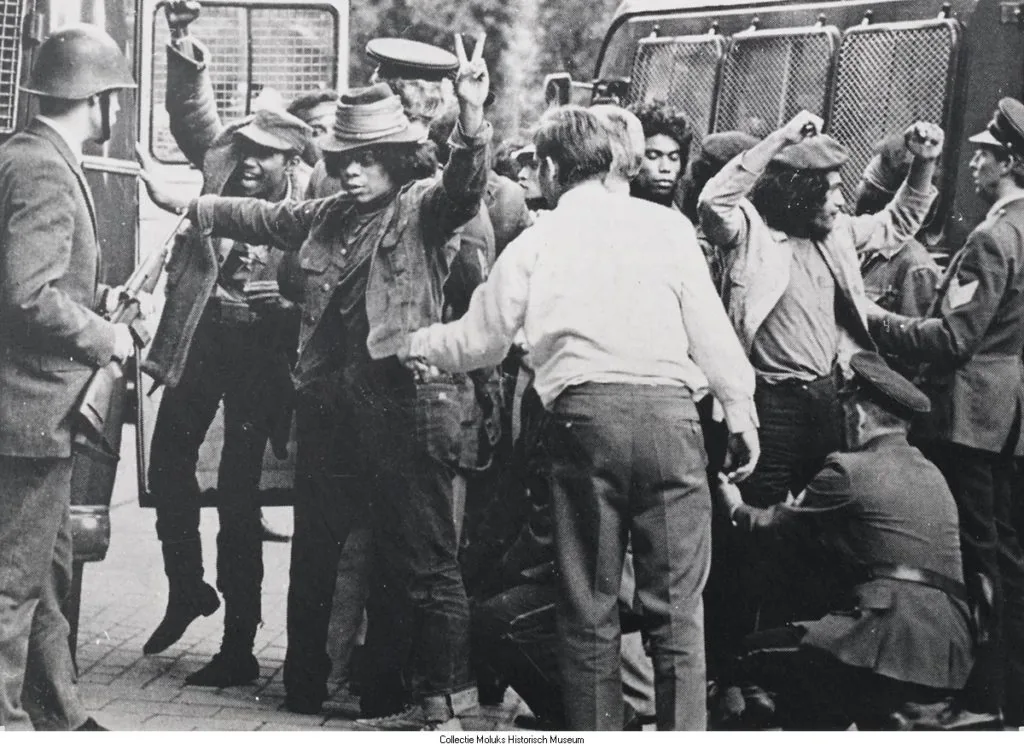
From Dutch society came a depoliticising response. The young people were said to have acted mainly out of anger about the treatment of their parents, and so not politically, and/or to be chasing their parents' dreams. The young people took a clear stand against these interpretations: it was their own idea, and the Netherlands should not imagine they had been stirred up by their parents.
Bridging and cooperation
Internally, the Wassenaar action bridged partly rival RMS movements. The RMS government in exile of ir. J. Manusama, founded in 1966 after the execution of mr. dr. Ch. Soumokil, had faced competition since 1969 from a counter-government led by general I. Tamaela. Both presidents had their own 'security corps' at their disposal. Tamaela's corps were called commandos, and Manusama's was the Korps Pedjagaan Keamanan (security guard corps). There was also a current of RMS young people who considered themselves independent and were not necessarily for either president. When it became known in the summer of 1970 that Indonesian president Suharto would come to the Netherlands on 1 September for a state visit, young people decided to give him a warm welcome.
The young people showed that they were able to set differences aside for the political goal
Members of Manusama's KPK got wind of that initiative and then took it over. The action grew into a plan to occupy three buildings: the Indonesian consulate in Amsterdam, the Indonesian embassy in The Hague and the Indonesian residence in Wassenaar. At the last moment only the last action went ahead. During the preparations the group involved in the action(s) grew. The young people came from all RMS currents, which made the Wassenaar action a sign of common purpose. They showed that they were able to set differences aside for the political goal.
For the Dutch authorities it was a wake-up call. The confrontations between Moluccan and Dutch peers had already convinced them that something had to be done about the relationship between Moluccans and Dutch society. People spoke of 'normalising' the relationship. One of the means they saw for this were foundations for community development, later simply called 'the foundation', for which every Moluccan neighbourhood could receive a subsidy. In the late 1960s good experiences had been had with, for instance, the Sou '66 foundation in Middelburg.
Normalisation with Indonesia
The Wassenaar action took the Dutch authorities by surprise, and with a shock they realised that the position of Moluccans in the Netherlands was also bound up with the Moluccas. In the 1990s, for my book 'RMS van ideaal tot symbool', I interviewed someone who had worked at the Dutch domestic security service (BVD) at the time. For them it was a wake-up call, he said. Alongside the relationship with Dutch society, work also had to be done on a 'normalisation' of the relationship with Indonesia. The BVD intensified its attention to Moluccans.
For a 'normalisation' of the relationship with Indonesia, the Netherlands needed Indonesia. At first the Indonesian government took the position that 'the Moluccan question' was a Dutch problem. After difficult negotiations, Indonesia was prepared to get the Netherlands out of its predicament. An agreement was reached that arranged, among other things, guided journeys by Dutch Moluccans to Indonesia (the orientation trips) and opportunities for repatriation for older Moluccans with Indonesian nationality. The organisation was in the hands of joint committees, one in the Netherlands and one in Indonesia.
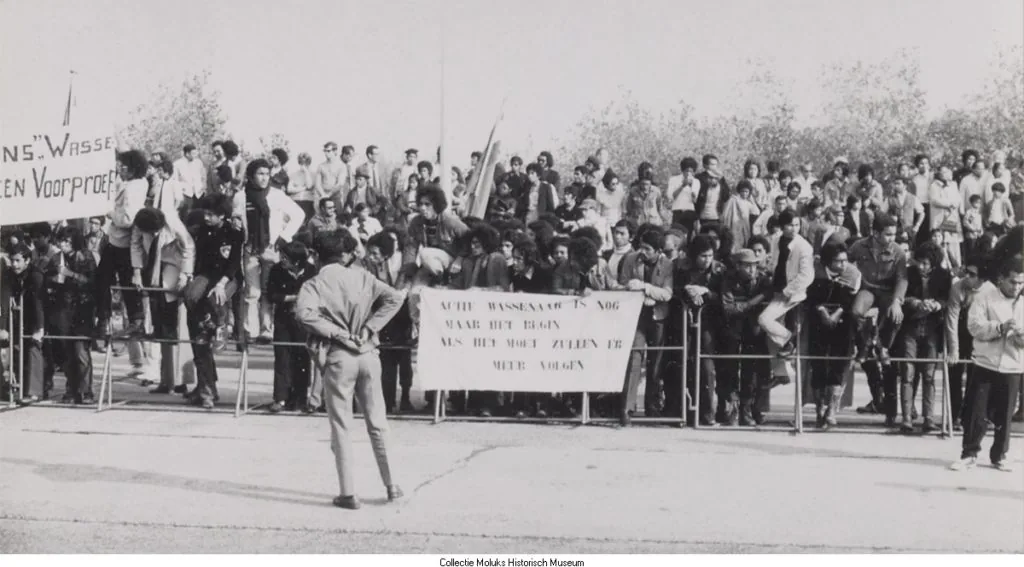
demonstration following the Wassenaar action
By the end of the summer of 1975 the agreement was ready and implementation could begin. In the meantime the Moluccan young people had concluded that the talks following the Wassenaar action had achieved nothing. New actions were, in their view, necessary. And they came, beginning with the train hijacking at Wijster and the hostage taking at the Indonesian consulate in Amsterdam in December 1975.
Because of the new actions, the announcement and implementation of the Wassenaar Agreement were postponed for a time. In the longer term, the eventual consequences of the orientation trips and other measures under the Agreement contributed to a changing position for Moluccans in the Netherlands. The impact of the Wassenaar action was therefore many times greater than anyone could have suspected in 1970, and than is generally recognised today.
Further reading:
Tete Siahaya, 'Mena Muria, Wassenaar '70: Zuid-Molukkers slaan terug', 1972
Henk Smeets & Fridus Steijlen, 'In Nederland gebleven; de geschiedenis van Molukkers 1951-2006', 2006 (chapters 8 and 9)
Fridus Steijlen, 'RMS van Ideaal tot symbool, Moluks nationalisme in Nederland 1951-1994', 1996 (chapter 6)