BAKU DENGAR: listening to what is not said outright
At Museum Arnhem, Baku Dengar does not unfold as a classic exhibition guiding you from work to work. It feels more like a journey in which memories, identity, colonial history and spiritual imagination are constantly in conversation with one another. The title loosely means "listening to each other", but as you move through the exhibition the feeling soon arises that this is not only about listening to one another, but also to what was long left unsaid.
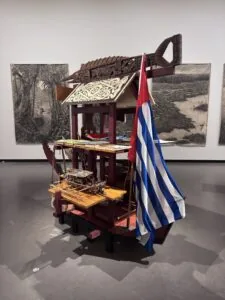
Right on entering, the monumental installations draw the eye. Wooden constructions, references to traditional architecture, archive images, flags, books and personal objects flow together into a layered whole. The work looks fragile and firmly anchored at the same time. As if past and present have literally been built on one another.
What stands out is the way history is not told linearly here. Instead, the works move between family stories, migration, the independence struggle, loss and cultural continuity. One of the installations shows a construction in which archive material, photographs and symbols come together. The Morning Star flag hangs visibly present beside personal images and documents. The work raises questions about home, diaspora and the way political history works through family lives.
It is allowed to exist side by side
That tension between collective memory and personal experience runs right through the exhibition. Some works feel almost ceremonial. Others confrontingly quiet.
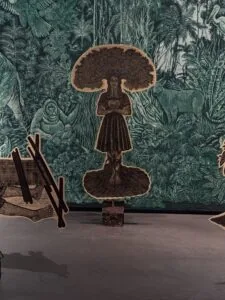
Nature also plays an important role within Baku Dengar. Large drawn landscapes fill the walls of the space. Forests, water, roots and animals appear not as backdrop but as a living presence. The jungle here is not an exotic image but a place of origin, protection and ritual. In one of the works a female figure is literally rooted in the landscape. Her body seems to coincide with the surroundings around her. As if identity cannot be seen separately from land, history and ancestors.
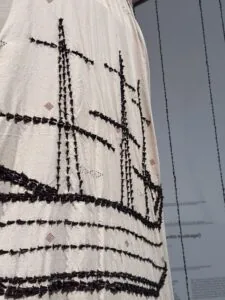
Baku Dengar refuses to give simple answers. The exhibition asks for attention and for slowing down. Many works contain details that only become visible when you keep looking. Threads, textile, woodwork, photographs and written fragments together form a language that does not have to be fully translated in order to land.
NUMANE: BUAYA INSTALLATION-PERFORMANCE
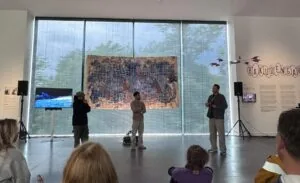
Visitors are welcomed by a large canvas. Made by NUMANE (Darsay, Jefta Tanate & Desley)
Blue and red strokes move across the surface as if still in motion. As if the work breathes. As if it is trying to hold on to something hard to put into words.
Darsay talks about the various movements used on the canvas, among them the footsteps and steps used in the war dances of TNS. At first Jefta dances cautiously, not yet making contact with the audience; the rhythm begins in the feet. Stamping. Grounding. Every movement carries meaning.
We see the dance of the buaya, the crocodile. About scales, strength and the shadow self. The symbolism of the crocodile is what the snake represents in the West. The snake is often seen as something sly, something slippery. A snake in the grass. But the crocodile carries a different weight. It is weighted, grounded, and despite its heaviness moves fluidly through water, mud and land.
Perhaps that is precisely where the strength of the symbol lies. The ability to move through difficult circumstances without losing yourself. Through resistance.
Because development is rarely linear. The phases of life we go through as human beings call for confrontation, for slowing down and sometimes for complete surrender.
Jefta Tanate performed the dance within this remarkable piece. He embodies the buaya. His movements are heavy and fluid at once, controlled but intense. Sometimes low to the ground, then explosively fast. Without words he tells the story of a body moving through mud, water and land. The audience falls silent. Not out of discomfort, but out of complete attention. At some moments Jefta bends his body to the limit, as if exploring the boundaries of tension and control. You almost physically feel what is being portrayed: struggle and transformation.
And perhaps that is what makes this performance so remarkable. That the shadow is not hidden away here, but allowed to be visible. That vulnerability and strength exist side by side. That movement becomes a way of making memories, emotions and identity tangible.
NUMANE shows that masculinity and sensitivity do not exclude one another. The men share stories about their experiences, about how life brought them together and how their collective came about. The bond between them shows a form of brotherhood built on trust, vulnerability and connection. That makes NUMANE not only a powerful performance group, but also an important example for many.
We will be seeing more of NUMANE this year. Keep an eye on our cultural agenda for upcoming performances and programmes.