The history of many Moluccans in the Netherlands begins in 1951, when more than 4,000 Moluccan KNIL soldiers and their families were brought to the Netherlands. What was intended as a temporary stay turned out to be permanent. For a long time participation in Dutch politics remained limited. For the first generations the focus lay on returning to the Moluccas and on the political struggle around the RMS. Dutch politics was often seen as something at a distance from the community.
Generations grew up in camps and later in Moluccan neighbourhoods scattered across the country. The first generation was focused on return. Closely bound to the Moluccas and to the realisation of an independent state. The political struggle and the activism of later generations kept this history visible in the Netherlands well into the 1990s. As the first generation passes, room also opens up for new forms of involvement. Where earlier generations often directed their political energy towards the Moluccas, younger generations are turning towards the society they grew up in.
*
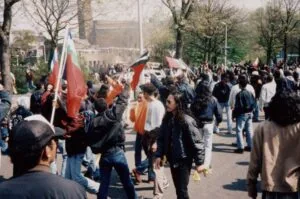
Youth demonstration in 1995, The Hague – Plein 1813 | photo Sharon Sourbag *
At the same time the growing presence of Moluccan candidates raises an interesting question. Do they act above all as representatives of the Moluccan community, or as politicians working for all the residents of their municipality? In practice both roles often come together. A candidate's background can be a source of motivation, but their political work ultimately addresses the wider society in which they live. Strikingly, Moluccan candidates are not tied to a single political current. They are active in various parties and bring a range of political convictions with them. That underlines that the Moluccan community is not politically uniform, but as diverse as the society it has been part of for decades.
For a number of candidates their background plays a part in their motivation. The Moluccan community is known for its mutual involvement and a strong sense of responsibility towards one another. Those values can also play a part in political ambitions: the wish to give something back to the community and to contribute to wider society. In Rotterdam, for instance, we see Michael Breems (List 5, DENK, number 11). His Moluccan background is the driving force of his campaign, but also the reason he is doing this. In recent years he has worked for change, so that both Moluccan and Indo residents of Rotterdam are heard. Breems: "Not talking about us, but with us." Or Anouk Kroesen – Suripatty of Partij Vrij Almelo, who lives in the Moluccan neighbourhood and works for the whole city. "I want to work for the interests of our citizens. With particular attention to older people, young people and safety in our neighbourhoods. Everyone deserves to feel heard, seen and safe, in every district," says Kroesen – Suripatty.
The presence of Moluccan candidates at these elections shows how the community has developed over 75 years. From temporary residents to citizens with a permanent place in society. From a community seen chiefly through the lens of its history, to a diverse community that takes an active part in shaping the future. For Museum Maluku this is a development that fits within a broader historical line. Generations of Moluccans have found their place in the Netherlands in culture, sport, education and entrepreneurship. That Moluccans now appear on electoral lists more and more often shows that politics, too, is no longer a field the community automatically stands outside of.
Perhaps you could even say: it was about time. After seventy-five years of presence in the Netherlands, political involvement is no longer an exception but a logical form of citizenship.