Column by Prof. Dr Fridus Steijlen
At the end of September the book 'De Slavernij in Oost en West; Het Amsterdam Onderzoek' ('Slavery in East and West; The Amsterdam Research') was presented. Three days later the presentation was followed by small-scale seminars on the theme at various places in the city. The latter because of the corona rules. The book 'Slavery in East and West' is a remarkable book. It is a 'state of the art', as people often say, a display of what is already known. Some forty people wrote in this book about various matters connected with Amsterdam and slavery.
The book
The reason for making the book was the city council's wish to apologise for Amsterdam's role in slavery. But to do that, one must first know what exactly one is apologising for. New research could not be carried out because time was too short (less than a year). The book therefore consists of 40 contributions on the involvement of Amsterdam, the city council and its members in slavery. The book describes the role of the council, what the public could know and how they too were affected by slavery through products made by enslaved people, but it also describes how that past still influences life in the present.
I had the honour of sitting on the academic advisory committee. In that position I could see how the authors and editors worked hard to produce a final product of quality. But it also meant that I was allowed to read the material before the final product was finished, since as a committee adviser I had to read along while the writing process was under way.
I honestly admit that I had my doubts when I began reading the forty-odd chapters. Small pieces of history about many different things. But the further I read, the more the text made everything clear. Reading it felt like doing a jigsaw puzzle of a thousand pieces: the more pieces could be laid, the clearer the whole picture became. And that was remarkable. The book shows how slavery was, and sometimes still is, bound up with society. The carriers who transported sugar and spices from Amsterdam to the interior also earned their living transporting goods made by enslaved people. Today, large companies here bear a particular responsibility called 'ketenverantwoordelijkheid' (chain responsibility), meaning that they must be able to guarantee that the goods they sell in their shops were not made by slave labour or child labour. This 'chain responsibility' is something that exists today and certainly did not exist in the past. But we are also made aware that the attention always directed at the trans-Atlantic slave trade, however natural that may be, clouds our view. Because in what is called in Dutch 'de Oost' (the East), slavery of course existed too.
What did we learn?
In the days before the book was presented, one of my Moluccan friends asked what I had learned from the text. "A great deal," I answered, but one thing in particular. Namely that we need a 'new lens' (a new way of looking) to see colonial history in Asia, Indonesia and Maluku.
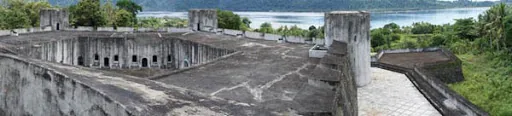
For a long time we have in fact used euphemistic terms when speaking or writing about slavery and forced labour. When we talk about the 'perken' (plantation estates) on Banda, after the massacre by J.P. Coen in 1621, we speak of people who were enslaved and then given to others to work the land, but we speak less about the 'perkeniers' (landowners) who were also beneficiaries of forced labour. We speak of a 'monopoly' on the spice trade, which sounds like an economic method, while Moluccan farmers were in fact forced to work for quantities determined by the VOC. That too counts as forced labour. In the later colonial period we speak of 'herendiensten' as a form of paying tax ('herendiensten' was a system in which farmers were obliged to work for, and hand over part of the produce of the land to, a lord who also owned the land, receiving that lord's protection in return), but in doing so we are in fact still talking about forced labour and the deprivation of freedom by a foreign ruler. And then there are the women who, as nyai, were treated like property by their colonial masters. Fortunately this piece of history has recently become a subject for writing, but for a very long time it was not. Forced relocation also occurred systematically in Asia. There, many people were enslaved and then traded and taken from one place to another. That trade was not a 'special economic activity' of the Verenigde Oost-Indische Compagnie (VOC, Dutch East India Company) in the way it was for the West-Indische Compagnie (WIC, Dutch West India Company). It is therefore less well known as a VOC activity, but even if less well known it still happened. What I learned, I concluded, is that we need a new way of looking at colonial history in Asia. A way of looking that gives us the ability to see forced labour and slavery better and more truthfully. Not in order to create a competition in slavery between 'de Oost' (the East) and 'de West' (the West). The effects of trans-Atlantic slavery are still felt today, in Asia too. But for far too long we have wrapped it euphemistically in economic terms. What matters is seeing it and naming it. In that way we can find the differences and the similarities and move forward.
The moment
"That is what I learned," I said to my friend. Then came the presentation and the seminars, with a great deal of media attention. I then realised that Amsterdam city council had, perhaps without planning it, created a momentum. They could simply have apologised and we would have talked a little about that apology. But what happened was that a moment emerged before the apology in which existing knowledge about the Dutch past of slavery, and particularly in Amsterdam, came into focus. At that moment global slavery was discussed, and with it slavery in 'de Oost' (the East), where Banda was discussed as one of the first places where the Dutch systematically used enslaved people. And the whole of the Netherlands was a witness to it.
This is the moment to put on a new historical lens and look again at the colonial era in relation to slavery in Asia.