Who protects the land?
On adat, land, law and what is passed on to a new generation
Last Saturday, the seminar Adat and the Moluccas at Museum Sophiahof focused on a concept that is difficult to capture in a single English word: adat.
The seminar was presented by Ron Habiboe and Rob Tupan, in collaboration with Universitas Pattimura, Museum Maluku and Museum Sophiahof. Prof. Dr Pieter Kakisina and Dr Revency Vania Rugebregt attended on behalf of Universitas Pattimura. Historian Wim Manuhutu moderated the discussion.
The central question was what adat and its relationship to national law mean for Moluccans in the Netherlands. But over the course of the morning, an even more fundamental question emerged:
Who protects the land?
Adat is more than tradition
Adat is sometimes translated as tradition or custom, but that does not do justice to the concept.
Adat is an overarching system of rules, relationships, rights, responsibilities and practices passed down within communities from generation to generation. It can concern how a community is organised, who holds authority, how people relate to one another and what responsibilities they have towards their surroundings.
The precise form this system takes differs from one island, region and community to another.
Adat therefore encompasses several different concepts. A negeri, for example, is the community and territory within which adat takes shape. Soa refers to kinship and organisational structures. In many negeri, a raja/kepala desa holds a traditional position of authority, while saniri refers to a governing or consultative body.
Relationships between communities also have a place within adat. Pela refers to historical alliances between negeri, while gandong is connected to kinship and shared origins. The baileo is a communal space where adat matters, among other things, can be addressed.
When the legal dimension is central, we speak of hukum adat: adat law or customary law.
These are therefore not simply different words for the same thing. They show how broad adat is: encompassing family and community, governance, law, land and responsibility.
It was this final aspect that we examined more closely during the seminar.
Sasi: when a community sets a boundary
Sasi is probably one of the best-known examples of adat in the Moluccas.
An area, crop or natural resource can be closed off from use for a certain period. Harvesting or fishing, for example, may be temporarily prohibited.
But behind such a prohibition lies a broader principle. Sasi is also about who may use something, when they may use it and when a community decides that it must be left undisturbed. It therefore concerns responsibility for land, sea and natural resources. Not everything that is available has to be used immediately.
As a team, for example, we applied sasi to the exhibition In Eigen Woorden. Before the exhibition opened to visitors, the space was temporarily closed. During that period, staff members were also prohibited from entering the exhibition.
Sometimes something needs time to grow or recover before people can make use of it again. This makes sasi more than a tradition. It is also a way in which agreements about use and protection can be put into practice within adat.
Matakau: making protection visible
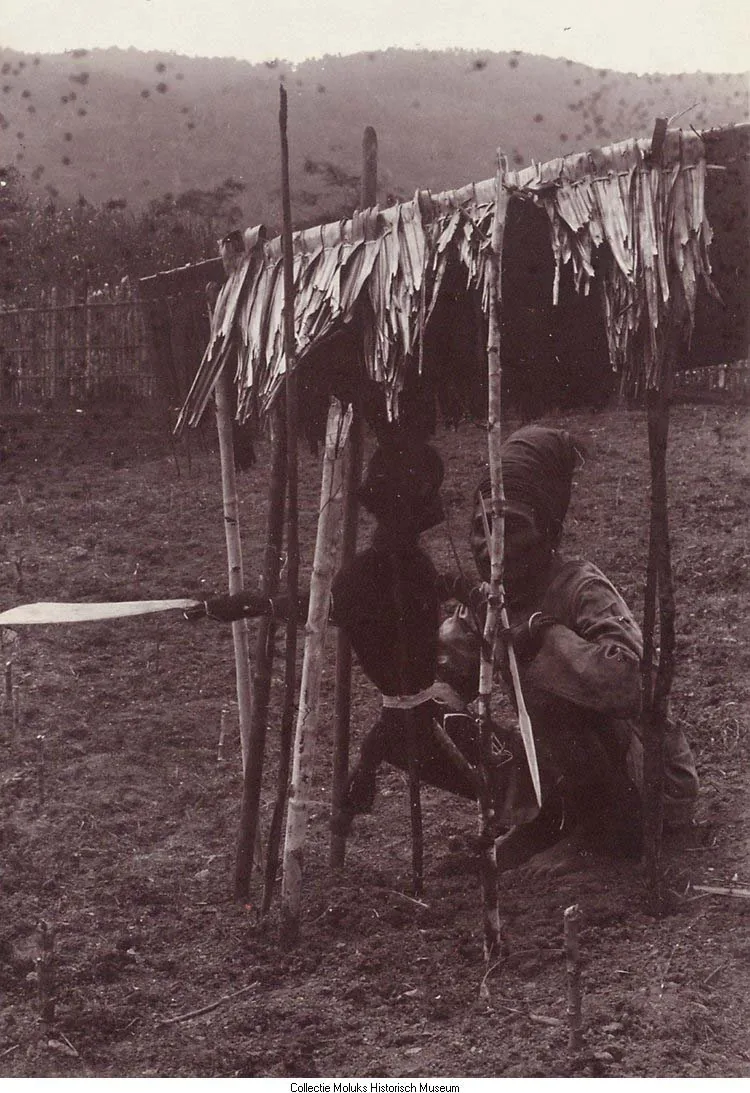
Matakau was also discussed alongside sasi. One historical photograph from our collection, for example, shows a matakau with an Alfur person standing behind it. Within certain communities, a matakau can be used to protect land, crops, possessions or natural resources against unauthorised use.
While sasi tells us something about a rule or restriction, matakau brings us to protection, warning and the marking of a boundary.
The two are not the same, but both can be understood as part of the broader world of adat. Someone looking only at a matakau might see it as something mysterious, spiritual or magical. Without the context of adat, however, we miss an important part of the story. Although adat is often associated with the supernatural, spirituality and ancestor veneration, reducing it to those elements does the concept an injustice. Adat is not necessarily a religion. It encompasses practices, rules, values and agreements that determine how people within a community relate to one another, their surroundings and their heritage.
The more interesting question is not only: what are we looking at? It is also: what is being protected here, from whom, and who has the authority to establish that protection?
This takes us from an object or practice to a much larger discussion about land and law.
Who has the right to decide?
Within a negeri adat, structures of authority, rights and mandates have developed over time. The position of the raja is part of this.
Alongside this is Indonesia’s formal system of government, in which the kepala desa – literally the village head – performs an administrative role.
Complicated questions arise precisely where these systems meet.
Through adat, a community may know which families are connected to a particular piece of land, who holds a mandate or who possesses certain rights. But when such a right must be defended within the formal legal system, orally transmitted knowledge alone may prove insufficient.
The question then becomes:
How do you prove a right that has been recognised within the community for generations when formal documentation is missing?
This makes documentation important.
During the seminar, participants discussed training programmes in which people learn to document what is happening in different parts of the Moluccas and how such situations relate to national law. This may sound administrative, but it touches on something fundamental. If knowledge about rights, boundaries and mandates is mainly passed down within communities, missing documentation can ultimately affect their ability to defend those rights formally.
This is where tension arises between hukum adat and national law.
But do young people still know adat?
Looking around the room during the seminar, most of those present were middle-aged or older adults. There were fewer younger faces. This was particularly noticeable in a discussion about the survival and transmission of adat.
This vulnerability does not lie only in laws and documents. It also lies in the passing on of knowledge. Many young people know that adat exists. They may recognise words such as sasi, pela, gandong or raja. They know practices from their family or negeri.
But knowing that something exists is not the same as understanding why it exists.
Why is certain land protected? Where does the authority of a raja come from? What does a mandate mean? Why is harvesting prohibited for a certain period? And what responsibility do you have towards land that has been connected to a community for generations?
This may be one of the most important tasks for the future of adat.
It is not enough to explain what the rules are. We must also explain where they come from and which values they protect.
Teaching young people about sasi also teaches them something about boundaries. About responsibility. About the idea that nature is not only something to take from, but also something to which you have a duty.
Adat, faith and change
Faith also makes the conversation about adat complex. Some adat practices are associated with spirituality and ancestors and can conflict with Christian or Islamic beliefs. At the same time, sasi gereja shows that adat and faith can also become intertwined.
Adat is therefore not static. It changes and takes on new forms within communities. This makes one question especially important: what meaning will new generations give it?
And what does this mean for the Netherlands?
This brings us back to the seminar’s central question: what does adat mean for Moluccans in the Netherlands?
Protecting land and natural resources may seem far away, but our consumption is connected to it. What we buy, eat and use here has consequences elsewhere. A principle such as sasi therefore has meaning here too: not everything that is available has to be taken immediately.
Adat from afar
For Moluccans in the Netherlands, this creates another area of tension. Through ancestry and family ties, people may feel connected to a negeri, the land of their ancestors and the adat associated with it. That connection can also create a sense of responsibility for protecting the land.
But a right recognised within adat does not automatically have the same meaning under national law. This can be particularly complicated for descendants in the Netherlands who are not Indonesian citizens.
This tension does not exist in isolation. Questions concerning ancestry, land, authority and the protection of natural resources arise more often and also resonate within the Moluccan community in the Netherlands. The seminar made clear that people encounter legal limits and are looking for ways to advocate for these interests from the Netherlands. Participants also discussed whether other legal avenues, at European level for example, might have a role to play. The seminar did not produce a definitive answer; above all, this shows how current and complex these issues are.
What does a right or responsibility derived from adat mean when it cannot be exercised in the same way within the formal legal system?
This is an essential question for the Moluccan diaspora. Distance from the Moluccas does not sever family history or a sense of connection, but it can affect the formal options available for acting on that responsibility from the Netherlands.
There may be no simple answer. That is precisely why it is important to keep these conversations going: between generations, between the Netherlands and the Moluccas, and between adat and formal law.
The seminar Adat and the Moluccas did not bring that conversation to an end. Museum Maluku expects to organise more seminars like this in the future, creating space for knowledge, different perspectives and questions that do not always have a simple answer.
Because passing on adat begins not only with knowing what it was, but also with exploring together what it means today.