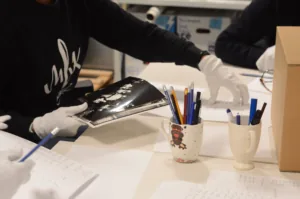
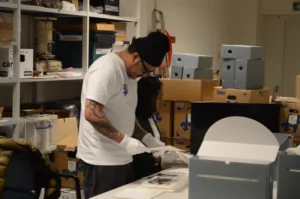
It was a process of leafing, lifting, sorting and above all: looking, and looking again.
Every photograph literally passed through our hands. With white gloves, carefully and attentively. Sometimes silence fell, because an image landed. Sometimes there was laughter at old acquaintances, at hairstyles from another time, at places that are still recognisable. Music played while we worked, memories were shared and conversations arose about then and now.
What made these days special was who sat at the table. Three generations, each with their own perspective and connection to the past. The selection process thus became more than a practical task; it became a moment of encounter.
For In Eigen Woorden we chose three guiding sentiments: pleasure, community spirit and resistance. These were the compass in the selection process.
It soon became clear: this archive is not a static collection but a living memory. Selecting therefore meant looking not only at aesthetics, but above all at representation. Which images tell who we are? Which contribute to the story we want to share together?
The images eventually chosen form a visual narrative in which personal memories and collective history flow into one another.
More than an exhibition
Museum Maluku is a community museum. We work for and with the community to keep heritage and culture alive. With In Eigen Woorden we bring together not only images, but also voices, perspectives and questions.
Because many photographs lack context. Who is in them? Where were they taken? Who made them?
That is why we are actively working on enriching our collection with metadata, together with the community. Earlier this year we held a pilot for community crowdsourcing at Kamp Vught. A first step in a longer trajectory in which shared ownership is central.
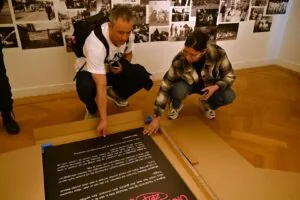
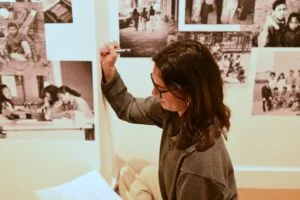
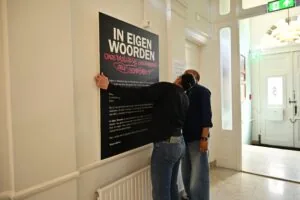
During the installation, too, that care remained palpable. Every photograph was given an object number, applied by hand. In pairs we worked our way through the space, image by image. An intensive process… by now we could recite the numbers in our sleep.
When we first walked into the hall as a team, it landed.
"I see my grandfather and grandmother again."
"I feel connected, even though I did not grow up in the neighbourhood."
There was recognition, pride, but also the awareness that many people in the photographs are no longer with us. Sorrow and joy existed side by side.
What we preserve determines what we pass on
On 18 March the installation was complete. Following Moluccan tradition we closed the space ritually with sasi.
Sasi is a centuries-old custom within adat: a system of temporary closure, intended to safeguard balance, respect and sustainability. What is closed is given time. What is protected gains value.
Until the opening the exhibition remained shielded, not only physically but symbolically. A moment of rest, before it is shared.
The evening of the opening
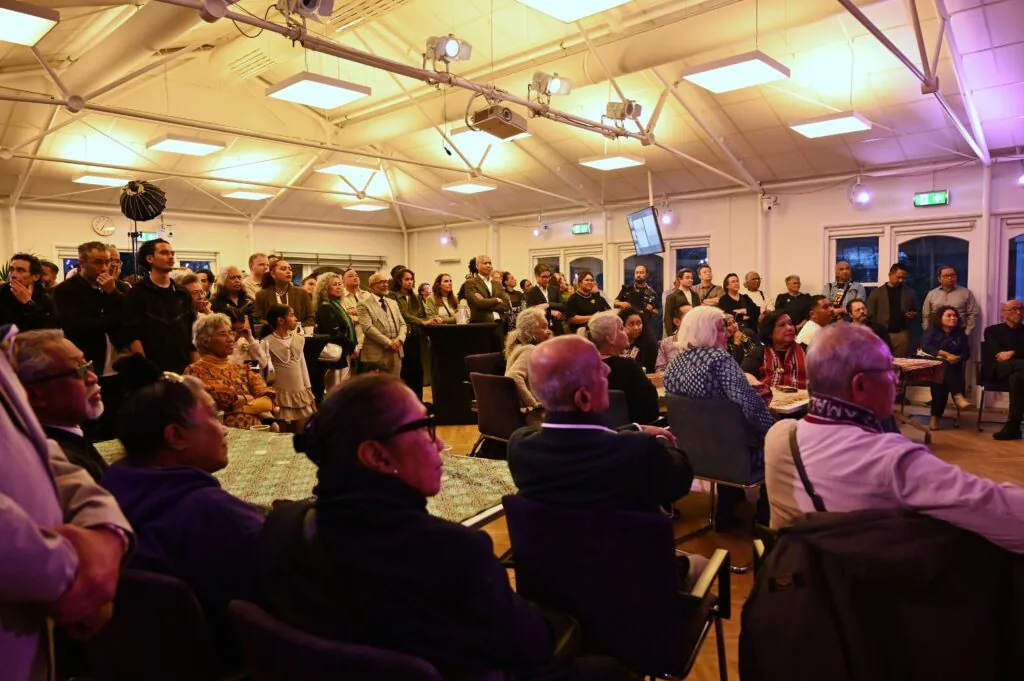
The anticipation was palpable and the hall was full. Among ourselves we joked that it looked more like a pesta than a formal opening.
Guests were welcomed by Moesha, made a first memory in Phobu's photo booth and sat down to a warm meal provided by Nona Malesi. Meeting came first, even before the exhibition was viewed.
The opening words were given by board member Ezra Papilaja, followed by an explanation from Yanise Zijlstra. Director Henry Timisela then invited everyone to enter the hall.
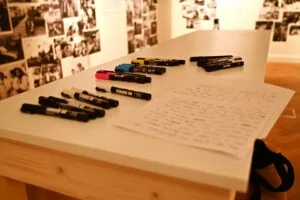
Although the markers were ready and we as a team had put examples on the walls, an invitation to add the names of loved ones, it felt almost unreal.
As a child, after all, you learn not to draw on walls. Let alone with paint markers, and yet that was exactly the intention.
For a moment there still seemed to be hesitation in the room. But once someone wrote the first name, more soon followed. In fact we ran short of markers… It was as if something had been released. Name after name appeared on the walls. Places, memories, small notes. Fragments of lives that became visible again.
People who were writing were approached by others who recognised the same people. Conversations arose spontaneously. Stories were added to, memories shared and, more beautifully still, history was written.
Thank you to everyone who worked on this exhibition and who took care of the opening with such careful hands.
The exhibition In Eigen Woorden can be seen at the Sophiahof until 26 September 2026. Plan your visit here.