Visual language What if words are not needed to tell stories? That is the question I asked myself when I first wore a sarong and felt the cooling batik against my skin. The shapes and motifs told stories about the land, the sea and the mountains that Nusa Ina (mother earth) has given us. A story about creation and about the love for a land I can only call home. The sarong is among the oldest forms of clothing in South-East Asia and the island world where we as a community have our roots. This rectangular cloth has been worn for thousands of years. Originally it was not a fashion item but protection against the climate and a carrier of identity. In pre-colonial societies the sarong played a central role in daily life and in ritual.
Each region and community had its own ways of weaving, dyeing and decorating. Motifs and colours referred to origin, social status, stage of life, spiritual beliefs or specific ceremonies such as weddings, mourning rituals and rites of passage. Sarongs were woven by hand and dyed with natural pigments; the making itself often had a ritual or symbolic meaning. With the arrival of trade routes came an exchange of techniques and patterns. Ikat, batik and songket techniques, among others, found their way across islands and continents. Even so, every region kept its own visual language. During my research into different patterns and motifs my eye fell on a book in which the visual language of the sarong on the Tanimbar Islands is carefully examined. There, even during the colonial period, the sarong remained strongly bound up with ancestor veneration and oral history: textile functioned as a form of archive.
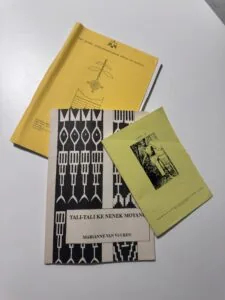
Various books from the Museum Maluku archive (Baku Sajang, Tali-Tali Nenek Moyang & Uele 6)
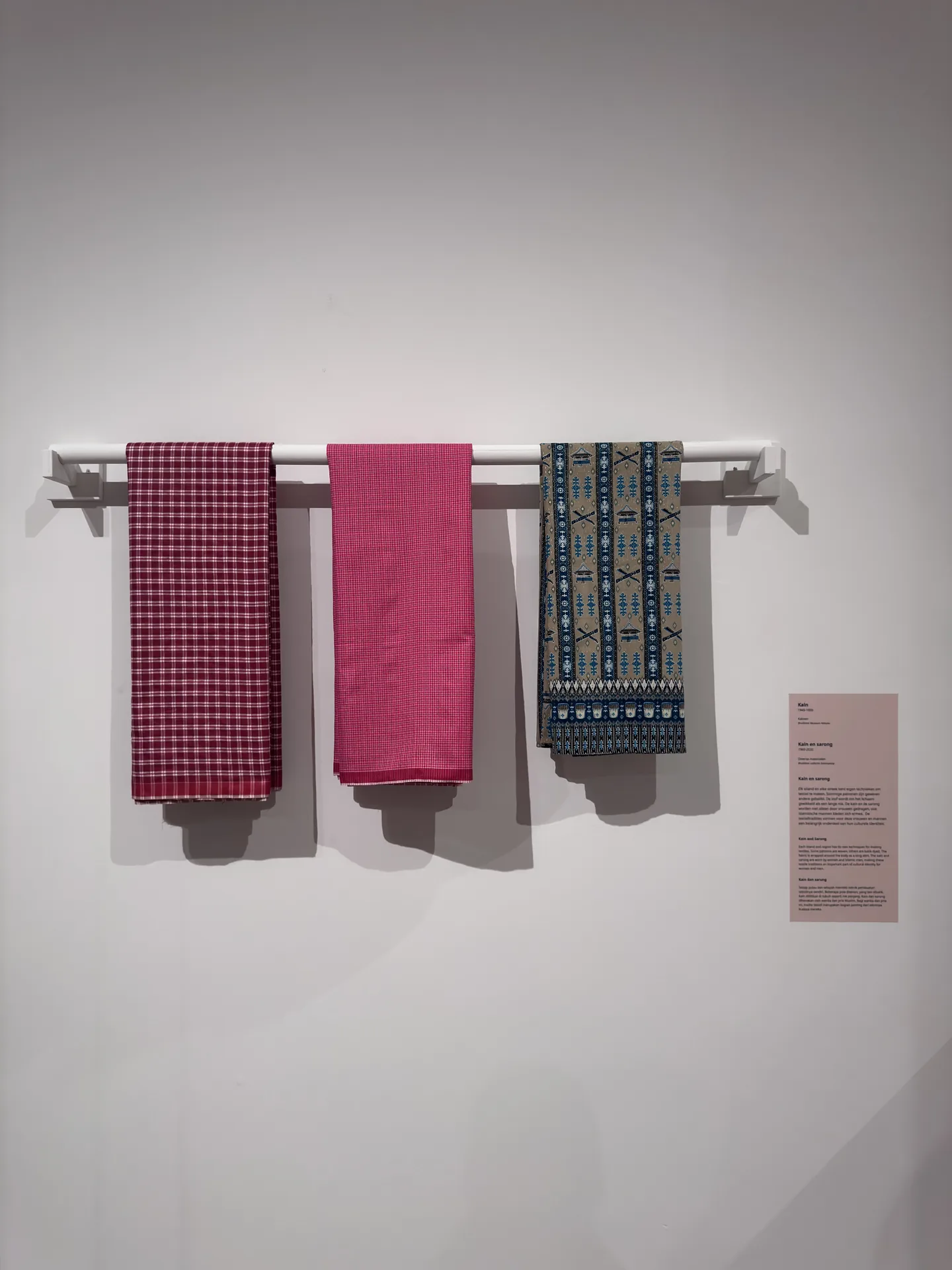
The role of the sarong changed profoundly under the influence of industrial production and Western clothing norms. Traditional textile practices came under pressure. At the same time the sarong became a symbol of local identity and resistance, something of one's own set against imposed foreign structures. Today the sarong moves between tradition and contemporary expression. In the hands of artist Jiwa Alami the motifs and patterns can be read anew. Not only as textile, but as a carrier of stories, memories and cultural continuity.
Natural soul
Jiwa Alami is an artist and tattooist. He is also a tifa player and, as I would describe him, an all-round storyteller. His work found its way to my screen in a remarkable way after we met during Roots on Deck | Ombak Anak Maluku, where Jiwa Alami played tifa during the performance of Tenggara '93. After that I felt an almost spiritual nudge towards curiosity: who is he? He turns out to be an artist who lets his work speak for itself. Motifs, patterns and different cultures come together in his hands.
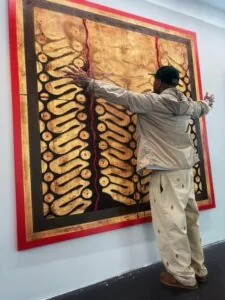
Jiwa Alami in front of his work btk parang
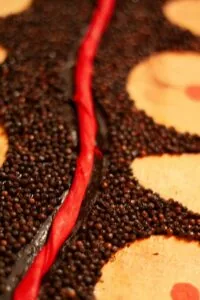
Close-up of the work btk parang
To my surprise I discovered that he creates his own pigments, as our forebears did, but in a new guise. In the short documentary you see how he makes these pigments from spices we know from our kitchens: cloves, nutmeg, mace, pepper, sago and cinnamon. The scents and colours of our ancestors form a direct link to a history inextricably bound up with the Netherlands. Jiwa Alami tells how peppercorns were once so precious that you could, so to speak, build a villa with them. That is said to be the origin of the Dutch expression "peperduur" (pepper-expensive). The pain bound up with this reality deserves to be told. His art tells more than his personal history alone; it is also the history of the Moluccas and beyond.
Watch the short documentary about Jiwa Alami here
In his work we see the use of batik patterns. Although batik is not Moluccan in origin, for him it is inextricably bound up with his identity. It takes him back to his grandmothers in their batik sarongs and his grandfathers in their batik shirts. He describes it as home: a connection he weaves into his work as a tribute to his forebears. During our conversation he talks about making his first exhibition. He wanted to do something unique. That is how the Moluccan paint came about. He tested various bases and experimented with how the spices could be mixed on the canvas. He told me he used sago as a binding agent to strengthen the batik, and that the spices in the quadriptych are worked into gold. That gold is not only an aesthetic choice but a form of resistance. A statement: for you it was the Golden Age, for us the price was pepper-expensive.
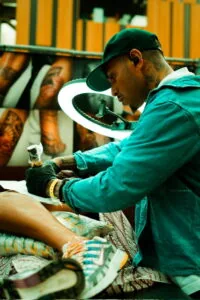
Jiwa Alami at the Amsterdam tattoo convention 2025
Jiwa Alami breaks patterns. In his tattoos you see a combination of Javanese and Balinese motifs. Although the creative process differs from making his canvases and paintings, one thing is clear: he embraces the art of speaking visually. Behind the scenes Jiwa Alami is working on a new exhibition in which all the senses are addressed: hearing, sight, smell, touch and taste. So that visitors do not only look at his work, but experience it.